Key takeaways
- TSH is the first-line thyroid test because it is the most sensitive early indicator of thyroid dysfunction.
- TSH moves in the opposite direction to thyroid hormone: high TSH suggests an underactive thyroid, low TSH an overactive one.
- Routine screening of asymptomatic non-pregnant adults is not recommended by the USPSTF, though many clinicians test liberally when symptoms overlap.
- Thyroid antibodies identify autoimmune causes — Hashimoto's and Graves' disease — and help predict who will progress.
- Biotin supplements can badly distort thyroid results. Stop them for a few days before testing.
Fatigue. Weight that will not shift. Cold hands. Brain fog. Hair thinning. These are among the most common complaints brought to American primary care, and the thyroid is the most common suspect. Sometimes it is the culprit. Often it is not — and understanding what a thyroid panel can and cannot tell you saves a great deal of frustration.
How the thyroid system works
The thyroid is a butterfly-shaped gland at the base of the neck. It produces two hormones: thyroxine (T4), which is mostly a reservoir, and triiodothyronine (T3), the more active form, which is largely converted from T4 in peripheral tissues. Together they set metabolic rate, influencing heart rate, temperature regulation, gut motility, cognition, menstrual function and mood.
The pituitary gland monitors circulating thyroid hormone and secretes thyroid-stimulating hormone (TSH) to keep it in range. This feedback loop is exquisitely sensitive, which produces the single most counterintuitive fact in thyroid testing: TSH moves opposite to thyroid function. When the thyroid underproduces, the pituitary pushes harder and TSH rises. When the thyroid overproduces, the pituitary backs off and TSH falls.
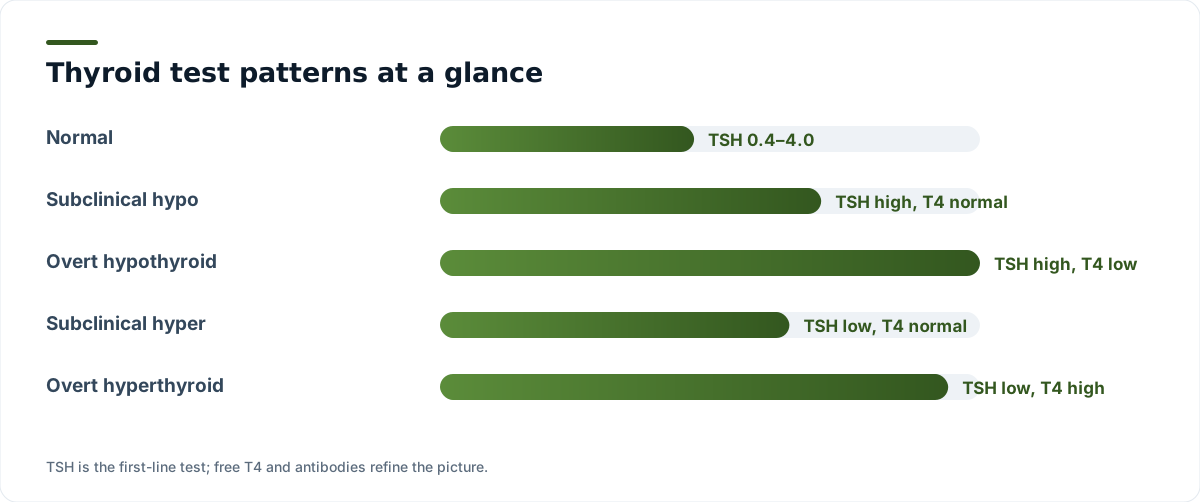
Because the pituitary responds to small changes, TSH shifts before T4 leaves the normal range. That sensitivity is why TSH is the screening test and why an abnormal TSH with a normal free T4 has its own name: subclinical thyroid disease.
The tests, and what each adds
TSH
Typical reference range is roughly 0.4 to 4.0 mIU/L, though laboratories differ and the upper limit for older adults is legitimately higher. TSH also has a daily rhythm, peaking overnight, so morning and afternoon draws can differ by a meaningful amount in borderline cases.
Free T4
The unbound, biologically available fraction of thyroxine. Added when TSH is abnormal, to distinguish subclinical from overt disease, and used as a first-line test when pituitary disease is suspected.
Free T3 or total T3
Most useful in suspected hyperthyroidism, where T3 can rise before T4. It is much less useful in hypothyroidism, where it is often normal, and is over-ordered by people investigating fatigue.
Thyroid peroxidase (TPO) antibodies
Elevated in most people with Hashimoto's thyroiditis, the leading cause of hypothyroidism in the United States. Positive antibodies in someone with subclinical hypothyroidism predict a higher chance of progression to overt disease, which changes monitoring intervals.
TSH receptor antibodies / TSI
Used to confirm Graves' disease as the cause of hyperthyroidism, and important in pregnancy because these antibodies cross the placenta.
Thyroglobulin
Not a diagnostic test for thyroid dysfunction. Its main role is monitoring after treatment for thyroid cancer.
Biotin will distort your results
High-dose biotin — common in hair, skin and nail supplements — interferes with many immunoassays and can produce a falsely low TSH with falsely high free T4 and T3, a pattern that mimics hyperthyroidism convincingly enough to prompt unnecessary treatment. Stop biotin for at least two to three days before testing and tell the laboratory you were taking it.
Underactive thyroid
Hypothyroidism affects roughly 5% of Americans, with more undiagnosed. It is far more common in women and becomes more common with age. Symptoms build slowly and are easy to attribute to ordinary life:
- Fatigue and sleepiness that rest does not fix
- Cold intolerance
- Weight gain, usually modest — typically a few pounds of fluid, not dramatic
- Constipation
- Dry skin, brittle nails, hair thinning including the outer eyebrows
- Muscle aches, cramps and slowed reflexes
- Heavy or irregular periods, and reduced fertility
- Depressed mood, slowed thinking, poor concentration
- Elevated LDL cholesterol — untreated hypothyroidism is a recognised cause of an abnormal lipid panel
The most common cause is Hashimoto's thyroiditis, an autoimmune process in which the immune system gradually destroys thyroid tissue. Other causes include prior thyroid surgery, radioactive iodine treatment, external radiation, certain medications such as lithium and amiodarone, and — globally though rarely in the U.S. — iodine deficiency.
Treatment is levothyroxine, a synthetic T4 taken once daily on an empty stomach, separated from calcium, iron, coffee and antacids, all of which reduce absorption. TSH is rechecked about six to eight weeks after any dose change, because the system takes that long to reach a new equilibrium.
Overactive thyroid
Less common, and the symptoms are usually harder to ignore:
- Palpitations, rapid or irregular heartbeat
- Unintentional weight loss despite normal or increased appetite
- Heat intolerance and excessive sweating
- Anxiety, irritability, tremor
- Difficulty sleeping
- Frequent bowel movements
- Muscle weakness, especially in the thighs
- Eye changes — bulging, grittiness, double vision — specific to Graves' disease
Graves' disease is the most common cause. Others include toxic nodules, and thyroiditis, in which stored hormone leaks out during inflammation and causes a temporary hyperthyroid phase that often resolves or flips to hypothyroidism. Distinguishing these matters, because treatment differs: antithyroid drugs, radioactive iodine or surgery for true overproduction, versus supportive care for thyroiditis.
Untreated hyperthyroidism carries real risks — atrial fibrillation, accelerated bone loss and, rarely, thyroid storm.
The grey zone: subclinical thyroid disease
A TSH modestly outside the reference range with a normal free T4 is common, particularly in older adults, and does not automatically require treatment.
| Pattern | TSH | Free T4 | Usual approach |
|---|---|---|---|
| Subclinical hypothyroidism, mild | 4–10 mIU/L | Normal | Often observe and repeat in 6–12 weeks |
| Subclinical hypothyroidism, marked | > 10 mIU/L | Normal | Treatment usually considered |
| Overt hypothyroidism | High | Low | Treat |
| Subclinical hyperthyroidism | Low | Normal | Confirm, assess heart and bone risk |
| Overt hyperthyroidism | Low | High | Determine cause and treat |
A single abnormal TSH deserves repetition before any label is applied. Acute illness, recovery from illness, corticosteroids, dopamine and pregnancy all perturb the axis temporarily. This phenomenon — abnormal thyroid tests during non-thyroidal illness — is a well-recognised trap.
Should healthy people be screened?
The USPSTF concluded that evidence is insufficient to recommend routine screening for thyroid dysfunction in asymptomatic, non-pregnant adults. Several professional bodies favour testing older adults or those with risk factors. In practice, TSH is ordered liberally because its symptoms overlap with so many complaints and the test is cheap.
Testing is clearly warranted with symptoms, a goitre or thyroid nodule, a personal or family history of autoimmune disease, prior neck radiation, unexplained hyperlipidaemia, atrial fibrillation, osteoporosis, infertility or recurrent miscarriage, or when starting medications known to affect the thyroid.
Pregnancy is different
Thyroid hormone requirements rise substantially in pregnancy, reference ranges are trimester-specific, and untreated hypothyroidism is associated with adverse outcomes. Women who are pregnant, planning pregnancy, or already on levothyroxine should have thyroid function assessed early and monitored closely — this is one setting where the case for testing is not controversial.
Thyroid nodules
Nodules are extremely common and become more so with age; the great majority are benign. Evaluation typically starts with TSH and a thyroid ultrasound, with fine-needle aspiration reserved for nodules whose size and ultrasound features suggest risk. The main clinical challenge in the United States is the opposite of underdiagnosis: incidental nodules found on scans done for other reasons drive a great deal of testing for very small cancers that would never have caused harm.
The bottom line
Start with TSH. Add free T4 if TSH is abnormal, antibodies if you need the cause, and T3 mainly when hyperthyroidism is suspected. Repeat before acting on a borderline result, stop biotin beforehand, and remember that a normal thyroid panel in someone who feels unwell is useful information — it redirects the search rather than ending it.