Key takeaways
- A standard lipid panel reports total cholesterol, LDL, HDL and triglycerides. Non-HDL cholesterol is calculated from them and is often the more useful number.
- LDL is the number most treatment decisions revolve around, but the target depends entirely on your overall cardiovascular risk, not on a single universal cut-off.
- Fasting is no longer required for most routine lipid testing, though it still matters when triglycerides are very high.
- Cholesterol is only one input. Age, blood pressure, smoking, diabetes and family history all feed the risk estimate that decides what happens next.
- A single abnormal panel is not a diagnosis. Repeat testing and trend matter.
Few lab reports generate more anxiety and more confusion than a lipid panel. Four numbers arrive in a patient portal, often with red flags next to at least one of them, usually with no explanation attached. Then the internet supplies a decade of contradictory advice about eggs. Here is what those numbers actually measure, how clinicians use them, and what should and should not change based on the result.
What cholesterol actually is
Cholesterol is not a poison. It is a waxy lipid your body requires to build cell membranes, produce hormones including cortisol and the sex hormones, make vitamin D, and manufacture bile acids that digest fat. Your liver produces most of what you need; diet contributes the rest.
The problem is transport. Cholesterol does not dissolve in blood, so it travels inside protein-wrapped particles called lipoproteins. Two of them dominate the conversation. Low-density lipoprotein (LDL) carries cholesterol from the liver out to tissues, and when there is too much of it circulating for too long, LDL particles lodge in artery walls and start the slow inflammatory process called atherosclerosis. High-density lipoprotein (HDL) does something closer to the reverse, participating in the return of cholesterol to the liver.
This is why LDL is described as "bad" and HDL as "good", though both labels are cartoons. The biology that matters is exposure: how many atherogenic particles are in your bloodstream, multiplied by how many years they have been there.
Reading the panel, line by line
Total cholesterol
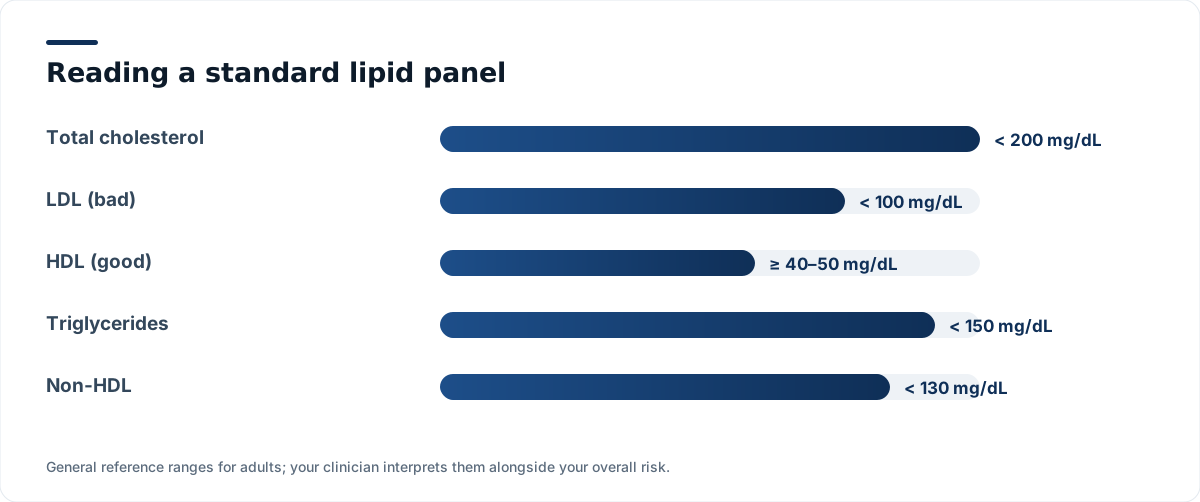
The sum of cholesterol carried in all lipoprotein fractions. Under 200 mg/dL is usually described as desirable. On its own it is the least useful number on the sheet, because a high total can reflect a high HDL, which is not a problem, or a high LDL, which is.
LDL cholesterol
The number that drives most decisions. Under 100 mg/dL is generally considered optimal for adults without established heart disease; 100–129 near optimal; 130–159 borderline high; 160–189 high; 190 or above very high. That last band deserves attention on its own, because an untreated LDL at or above 190 mg/dL often signals familial hypercholesterolemia, an inherited condition affecting roughly one in 250 people that dramatically accelerates heart disease and is badly underdiagnosed.
HDL cholesterol
Higher is generally better, with roughly 40 mg/dL as a floor for men and 50 mg/dL for women. Low HDL is associated with higher risk. Crucially, though, drugs that raise HDL have repeatedly failed to reduce heart attacks, which tells us HDL is more of a marker than a lever.
Triglycerides
A different kind of fat, strongly influenced by recent meals, alcohol, refined carbohydrate intake, insulin resistance and thyroid function. Under 150 mg/dL is normal, 150–199 borderline, 200–499 high, and 500 or above carries a real risk of pancreatitis and requires prompt attention. Elevated triglycerides frequently travel together with prediabetes, which is why our A1C guide is a natural companion to this one.
Non-HDL cholesterol
Total cholesterol minus HDL. It captures every atherogenic particle in one number and is not affected by whether you fasted. Many clinicians consider it a better predictor than LDL alone. A common target for people without heart disease is under 130 mg/dL.
Do you have to fast?
For most routine screening in adults, no. Non-fasting panels are acceptable and often more convenient, and the LDL and total values change relatively little. Fasting is still preferred when triglycerides are markedly elevated, when a very precise LDL is needed for treatment decisions, or when your clinician specifically asks for it. Follow the instruction you are given rather than assuming.
Who should be tested, and how often
Screening usually begins in early adulthood to establish a baseline. For adults without risk factors and with normal results, repeating every four to six years is a common rhythm. That interval tightens considerably if you have diabetes, hypertension, a strong family history of early heart disease, chronic kidney disease, an inflammatory condition, or if you are on lipid-lowering therapy and need monitoring.
There is also a case for testing children once between ages 9 and 11 and again between 17 and 21, primarily to catch familial hypercholesterolemia before decades of exposure accumulate.
Why your risk score matters more than your LDL
Here is the single most important idea in this article: there is no universal LDL target. The same LDL of 140 mg/dL means something entirely different in a 32-year-old non-smoker with normal blood pressure than in a 62-year-old smoker with diabetes and hypertension.
American practice therefore runs your numbers through a risk estimator that combines age, sex, total and HDL cholesterol, systolic blood pressure, treatment status, diabetes and smoking to produce an estimated risk of a cardiovascular event over the next ten years. Broadly, an estimated risk under 5% is low, 5–7.5% borderline, 7.5–20% intermediate and above 20% high. Treatment intensity scales with that estimate rather than with the LDL alone.
Several "risk-enhancing" factors push the decision toward treatment when the estimate lands in a grey zone: a family history of premature heart disease, persistently elevated triglycerides, chronic inflammatory disease, chronic kidney disease, South Asian ancestry, pregnancy complications such as preeclampsia, or an elevated lipoprotein(a). When the picture is still ambiguous, a coronary artery calcium scan can settle it — that test, along with ApoB and Lp(a), is covered in our advanced heart risk guide.
What actually moves the numbers
Diet. Reducing saturated fat and replacing it with unsaturated fat has the most consistent effect on LDL. Soluble fibre from oats, beans, barley, psyllium and many fruits binds bile acids and modestly lowers LDL. Dietary cholesterol itself — the egg question — turns out to matter far less for most people than saturated fat does, which is why guidance on eggs softened over the past decade.
Weight and activity. Regular aerobic activity has its clearest effect on triglycerides and HDL. Weight loss improves the whole panel, particularly triglycerides.
Alcohol. One of the most reliable triglyceride raisers. Cutting back often produces a dramatic drop within weeks.
Medication. Statins remain the best-studied lipid-lowering drugs, with decades of outcome data showing reduced heart attacks and strokes. Ezetimibe, PCSK9 inhibitors, bempedoic acid and, for triglycerides, icosapent ethyl and fibrates all have defined roles. The muscle symptoms statins are famous for are real for a minority of people and are usually manageable by changing dose or agent — stopping without telling your clinician is the outcome worth avoiding.
Other conditions. Untreated hypothyroidism, poorly controlled diabetes, kidney disease and certain medications can all raise lipids. A newly abnormal panel sometimes points at one of these rather than at diet. A TSH test is a reasonable part of that workup.
What to do with an abnormal result
- Do not panic over one panel. Lipids vary. Acute illness, recent weight change and laboratory variation all matter. Confirmation is standard.
- Get the whole picture. Ask for your calculated 10-year risk, not just your LDL.
- Ask about the very high band. An LDL of 190 mg/dL or more should prompt a conversation about inherited cholesterol disorders and about testing relatives.
- Set a recheck date. Lifestyle changes are typically reassessed after about three months; medication after roughly four to twelve weeks.
- Track the trend. Keep your panels in one place. The shape of the line over ten years tells you more than any single point on it.
The bottom line
A lipid panel is a snapshot of how much atherogenic particle traffic is moving through your arteries. It is genuinely important — the link between LDL and cardiovascular disease is one of the best-established relationships in medicine — but it is a component of a risk picture, not a verdict. Get the test, get the number, then get the context.