Key takeaways
- The value of an annual visit comes from a handful of well-chosen screenings, not from a head-to-toe examination.
- Blood pressure, weight trend, tobacco and alcohol use, mood and vaccination status belong at almost every adult visit.
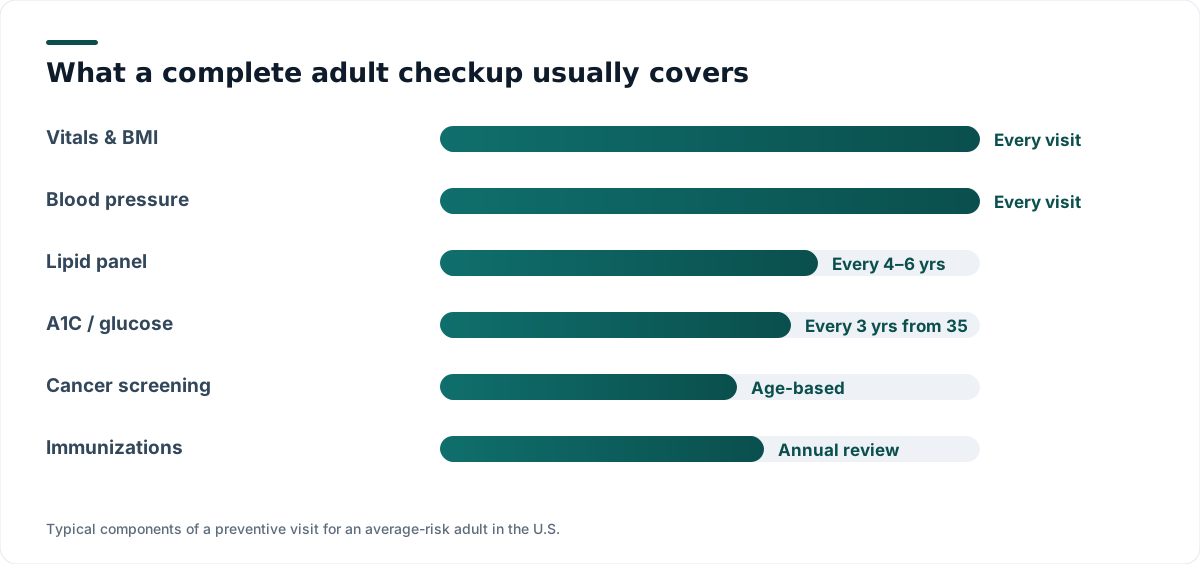
- Blood work is not automatically annual. Lipids every four to six years and A1C every three years is a common baseline for healthy adults.
- Most preventive services rated A or B by the U.S. Preventive Services Task Force must be covered without cost sharing by non-grandfathered insurance plans.
- Bring a written list. The single biggest determinant of what gets ordered is what gets discussed.
Ask ten Americans what happens at an annual physical and you will get ten different answers. Some picture a full battery of blood tests. Some picture a stethoscope, a reflex hammer and fifteen minutes of small talk. The honest answer is that a preventive visit is worth almost exactly as much as the specific screenings it triggers — and that the list of screenings worth doing is shorter, more targeted, and far more age-dependent than most people expect.
This guide walks through what a well-run adult preventive visit actually contains in the United States in 2026: what is nearly universal, what depends on your age, what depends on your risk, and what has quietly fallen out of favour despite still being ordered.
What a checkup is actually for
A preventive visit has four jobs. The first is screening: looking for conditions that are common, serious, silent in their early stages, and treatable if caught. High blood pressure, high cholesterol, prediabetes, colorectal polyps and depression all fit that description. The second is immunization: keeping vaccines current, which for adults usually means influenza, COVID-19, tetanus boosters, and age-triggered shots such as shingles and pneumococcal vaccines. The third is counselling: the unglamorous conversations about tobacco, alcohol, physical activity, sleep and contraception that change outcomes more than most tests do. The fourth is relationship: having a clinician who knows your baseline, so that when something changes there is a comparison point.
Notice what is not on that list. The classic physical examination — listening to the heart and lungs of a symptom-free adult, palpating the abdomen, checking reflexes — has surprisingly little evidence behind it as a screening tool. It is not harmful, and a skilled examiner occasionally finds something meaningful, but it is not where the value lives. The value lives in the blood pressure cuff and the conversation.
What belongs at almost every adult visit
Blood pressure. This is the single highest-value thing that happens at a checkup. Nearly half of American adults meet the definition of hypertension, and a substantial share do not know it. The measurement is free, takes ninety seconds and is the gateway to preventing strokes, heart failure and kidney disease. Our full guide to blood pressure screening covers how to make sure the reading you get is accurate.
Height, weight and the trend. A single BMI is a crude number. The trajectory over five years is genuinely informative, and unexplained weight loss is one of the more important findings in medicine.
Tobacco, alcohol and substance use. Screening questions here are brief, standardized and evidence-backed. Brief counselling from a clinician measurably increases quit rates.
Depression and anxiety screening. Two-question and seven-question instruments take under a minute and are recommended for adults generally. Mental health screening at a routine visit removes the need to make a separate appointment for something many people never get around to raising.
Vaccination review. Adults fall behind on vaccines more often than children do. A yearly check against the current adult immunization schedule takes moments.
What "covered at no cost" means
Under the Affordable Care Act, non-grandfathered health plans must cover preventive services that the U.S. Preventive Services Task Force grades A or B without applying a copay, coinsurance or deductible — when delivered in network. The catch is billing: if the visit shifts from "preventive" to "problem-focused" because you raised a new symptom, some of it may be billed differently. Asking the front desk how the visit will be coded is a fair and useful question.
The age-by-age screening skeleton
In your twenties and thirties
This is the decade of establishing a baseline. Blood pressure at least every one to two years. A lipid panel to establish where you start — many clinicians check once in the twenties and then space it out. Sexually transmitted infection screening according to activity, including at least one lifetime HIV test for everyone aged roughly 13 to 64, which our STI screening guide covers in detail. Cervical cancer screening begins at 21. Depression screening. A conversation about family history, which is the cheapest genetic test in existence and is repeatedly skipped.
In your forties
This is the decade where several clocks start at once. Screening for prediabetes and type 2 diabetes generally begins at 35 for adults with overweight or obesity, and our A1C guide explains the thresholds. Breast cancer screening now typically begins at 40 for average-risk women. Colorectal cancer screening starts at 45 for average-risk adults — a change from 50 that many people still have not heard about. Cardiovascular risk estimation becomes meaningful, and for some people that leads to the tests described in our guide to advanced heart risk testing.
In your fifties and sixties
Screening becomes denser. Lung cancer screening with annual low-dose CT applies to adults 50 to 80 with a significant smoking history — see our lung screening guide. Prostate cancer screening becomes a shared decision, typically framed between 55 and 69, discussed in our PSA article. Hepatitis C testing at least once in adulthood. Shingles vaccination from 50. Bone health enters the conversation, with DEXA scanning recommended for women from 65 and earlier for those with risk factors.
Seventy and beyond
The logic inverts. Screening only helps if you are likely to live long enough to benefit from finding something early, and the harms of over-testing — false positives, incidental findings, procedures with real complication rates — grow with age. Several screenings have upper age limits for exactly this reason. A good clinician in this decade talks about stopping tests as thoughtfully as they once talked about starting them. Falls prevention, hearing, vision, cognition and medication review quietly become the highest-yield items.
| Test | Typical start | Typical interval | Notes |
|---|---|---|---|
| Blood pressure | 18 | Every 1–2 years, annually if elevated | Confirm out of office before diagnosing |
| Lipid panel | 20s baseline | Every 4–6 years if normal | More often with risk factors or treatment |
| A1C / fasting glucose | 35 (with overweight/obesity) | Every 3 years if normal | Annually if prediabetes |
| Colorectal screening | 45 | Annual stool test or colonoscopy every 10 years | Several valid options |
| Mammography | 40 | Every 1–2 years | Interval varies by organisation |
| Cervical screening | 21 | Every 3–5 years by method | HPV testing preferred from 30 |
| Bone density | 65 (women) | Individualized | Earlier with risk factors |
The tests that are usually not worth ordering
An annual visit can also do harm, mostly through tests ordered out of habit. Routine electrocardiograms in symptom-free, low-risk adults find abnormalities that lead to further testing far more often than they find disease. Whole-body imaging marketed directly to consumers generates incidental findings at a remarkable rate. Broad "wellness panels" with dozens of analytes are almost guaranteed to produce at least one out-of-range value by statistics alone, and each one costs attention, money and sometimes a biopsy. Vitamin D testing in people without symptoms or risk factors is a good example — our vitamin D guide explains who genuinely benefits.
The right question is not "what else can we test?" but "what would I do differently if this result came back abnormal?"
How to get more out of the fifteen minutes
- Write three questions in advance. Bring them on paper or a phone screen and raise them at the start, not as you reach for the door handle.
- Map your family history. First-degree relatives with cancer, heart disease before 55 in men or 65 in women, diabetes or osteoporosis change your screening schedule. Ask relatives before the appointment.
- Bring your actual medication list. Including supplements, which interact more than people assume.
- Ask what is due. A direct question — "what preventive tests am I due for at my age?" — reliably produces a better answer than waiting to be told.
- Ask what you can stop. Deprescribing and de-screening are real and underused.
- Get your results in writing. Portal access is nearly universal now. Save the numbers; trends matter more than single values.
Do not wait for the annual visit for these
New chest pain or pressure, sudden severe headache, unilateral weakness or facial droop, unexplained weight loss, blood in stool or urine, a breast lump, a mole that has changed, or persistent shortness of breath are reasons to seek care now — not at the next checkup. Screening is for people without symptoms. Symptoms get evaluated on their own schedule.
The bottom line
The annual physical is not magic, and the version of it that involves a long list of unnecessary blood tests can actively waste your time and money. But a focused preventive visit — blood pressure, an honest conversation, an up-to-date vaccine record, and the two or three age-appropriate screenings that actually apply to you — remains one of the best-value hours in American health care. The trick is going in knowing what you are there for.