Key takeaways
- Roughly half of American adults have high blood pressure, and a large share are unaware of it or are not controlled.
- Hypertension in adults is generally defined as 130/80 mm Hg or higher, confirmed on repeated, properly taken readings.
- Technique matters enormously. A cuff on clothing, crossed legs, a full bladder or talking during the reading can each add several points.
- A diagnosis should normally be confirmed outside the clinic, with home readings or 24-hour ambulatory monitoring.
- Sodium reduction, potassium-rich eating, weight loss, activity, alcohol moderation and sleep quality all lower blood pressure measurably.
Hypertension has a public relations problem. It causes no pain, no visible sign and, in the overwhelming majority of cases, no symptom whatsoever until the damage it causes announces itself as a stroke, a heart attack, heart failure, kidney disease or vision loss. That is why it earned the name the silent killer, and why a ninety-second measurement remains one of the highest-value things that happens in American primary care.
The scale of the problem
Estimates from national surveillance data put the proportion of U.S. adults with hypertension at close to half when the 130/80 threshold is applied. Of those, only a minority have their blood pressure controlled to target. The gap is not mainly a treatment-availability problem: effective medications have been generic and inexpensive for decades. The gap is a detection and follow-through problem.
What the two numbers mean
Blood pressure is written as systolic over diastolic. Systolic — the top number — is the peak pressure in your arteries when the heart contracts. Diastolic — the bottom number — is the pressure between beats, when the heart relaxes and refills. Both are measured in millimetres of mercury, an artefact of the original mercury column manometers.
Systolic pressure tends to matter more for cardiovascular risk after about age 50, because arteries stiffen with age and systolic pressure rises while diastolic often falls. In younger adults, an isolated elevated diastolic reading carries more weight than people assume.
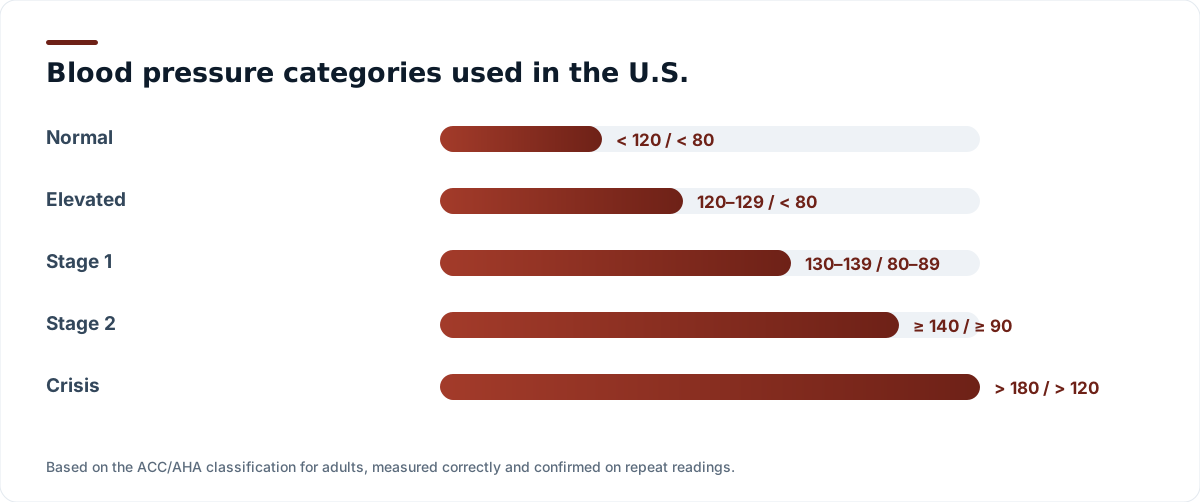
| Category | Systolic | Diastolic | Typical response | |
|---|---|---|---|---|
| Normal | < 120 | and | < 80 | Recheck in 1 year |
| Elevated | 120–129 | and | < 80 | Lifestyle change, recheck in 3–6 months |
| Stage 1 hypertension | 130–139 | or | 80–89 | Lifestyle change; medication if risk is high |
| Stage 2 hypertension | ≥ 140 | or | ≥ 90 | Lifestyle change plus medication in most cases |
| Hypertensive crisis | > 180 | and/or | > 120 | Urgent or emergency evaluation |
When a reading is an emergency
A reading above 180/120 with symptoms such as chest pain, shortness of breath, back pain, weakness or numbness on one side, difficulty speaking, or vision change requires emergency care immediately. The same reading with no symptoms still needs prompt medical attention — repeat the measurement after five minutes of rest and call your clinician if it stays that high.
Why technique changes the answer
Blood pressure is one of the few measurements in medicine where sloppy method routinely produces a clinically wrong number. Studies of real-world clinic measurement consistently find errors large enough to change a diagnosis. The main culprits are avoidable:
- The wrong cuff size. A cuff too small for the arm inflates the reading substantially. This is the single most common technical error.
- Talking during the measurement. Adds several points.
- An unsupported arm. The arm should rest at heart level on a surface. Holding it up raises the number.
- Feet dangling or legs crossed. Both raise readings.
- A full bladder. Adds roughly ten points in some studies.
- No rest period. Five quiet minutes seated before the first reading is the standard, and is skipped almost everywhere.
- Cuff over clothing. The cuff belongs on bare skin.
If your reading comes back high after a rushed measurement taken thirty seconds after you walked into the room, it is entirely reasonable to ask for it to be repeated properly. Good clinics do this as a matter of routine.
Confirming the diagnosis outside the clinic
Because clinic readings are unreliable in both directions, current guidance strongly favours confirming an elevated clinic reading with out-of-office measurement before labelling someone hypertensive.
White coat hypertension — high in the clinic, normal at home — affects a meaningful share of people and can lead to unnecessary treatment. Masked hypertension — normal in the clinic, high at home — is arguably more dangerous, because it goes untreated.
Two approaches confirm the picture:
- Home blood pressure monitoring. Use a validated upper-arm cuff monitor, not a wrist or finger device. Take two readings a minute apart, morning and evening, for seven days, discarding day one, and average the rest. A home average of 130/80 or above generally corresponds to hypertension.
- Ambulatory monitoring. A device worn for 24 hours taking automated readings, including during sleep. It is the reference standard and captures the nocturnal pattern, which itself predicts risk.
Buying a home monitor
Choose an upper-arm automatic monitor that has been independently validated, measure your arm circumference and buy the matching cuff size, and take it to an appointment once to compare it against the clinic device. A monitor with memory or app export saves you transcribing numbers.
Who should be screened, and how often
Screening is recommended for all adults 18 and older. Adults aged 40 and above, and anyone at increased risk — including people with overweight or obesity, and Black adults, who experience hypertension earlier and more severely on average — are generally screened annually. Younger adults with normal readings and no risk factors are often screened every three to five years, though annual measurement at any routine visit is common and harmless.
Children and adolescents are also screened at well visits, since paediatric hypertension is more common than it used to be and tracks into adulthood.
What actually lowers blood pressure
Non-drug approaches are not a consolation prize. Several produce reductions comparable to a low-dose medication.
| Change | Approximate systolic reduction |
|---|---|
| Weight loss | About 1 mm Hg per kilogram lost |
| DASH-style eating pattern | Roughly 8–11 mm Hg |
| Sodium reduction | Roughly 5–6 mm Hg |
| Increased dietary potassium | Roughly 4–5 mm Hg |
| Regular aerobic activity | Roughly 5–8 mm Hg |
| Limiting alcohol | Roughly 4 mm Hg |
Sodium deserves a specific note, because most American sodium intake does not come from the salt shaker. It comes from packaged foods, bread, processed meat and restaurant meals. Reading labels and cooking more at home moves the number far more than removing salt at the table. Potassium-rich foods — beans, leafy greens, potatoes, bananas, yoghurt — help counterbalance sodium, though people with kidney disease should discuss potassium with their clinician first.
Sleep is the underrated variable. Untreated obstructive sleep apnoea is a common cause of blood pressure that will not come down despite multiple medications, and it is worth investigating in anyone who snores heavily, is sleepy during the day, or has resistant hypertension.
When medication enters the picture
The decision to start medication depends on stage and on overall cardiovascular risk. Stage 2 hypertension almost always warrants medication alongside lifestyle change. Stage 1 usually warrants medication when estimated 10-year cardiovascular risk is high or when there is established heart disease, diabetes or kidney disease — which is why the lipid panel and blood pressure conversations are so closely linked.
Four medication classes carry the strongest first-line evidence: thiazide diuretics, ACE inhibitors, angiotensin receptor blockers and calcium channel blockers. Many people need two agents to reach target, and combination therapy started early is increasingly favoured over slowly escalating a single drug.
The bottom line
High blood pressure is common, silent, easy to detect and highly treatable — a combination that makes the detection gap especially frustrating. Get measured properly, confirm at home before accepting a label, know your two numbers the way you know your height, and treat a rising trend as information rather than an accusation.