Key takeaways
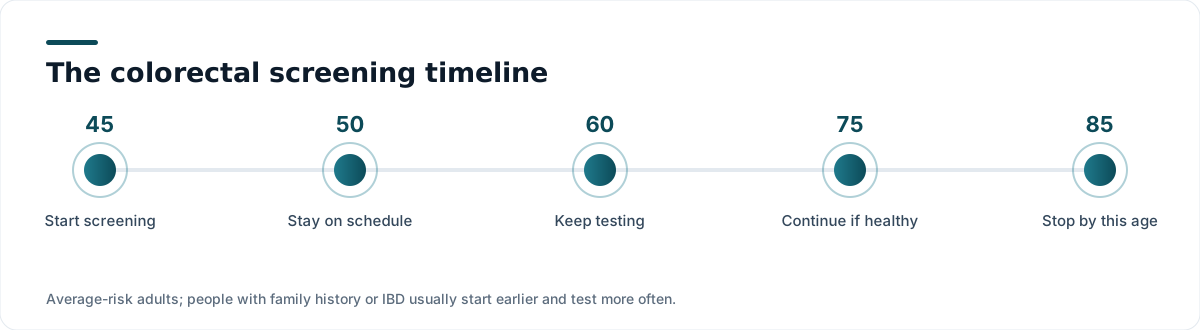
- Average-risk screening now begins at 45 in the United States, lowered from 50 because of rising incidence in younger adults.
- Colonoscopy is not the only acceptable option. Annual stool tests, stool DNA testing, CT colonography and flexible sigmoidoscopy all qualify.
- Colorectal cancer is one of the few cancers screening can actually prevent, by removing precancerous polyps before they become malignant.
- Any positive non-colonoscopy test must be followed by a diagnostic colonoscopy. That step is where programs most often break down.
- Family history changes everything — a first-degree relative with colorectal cancer usually means starting earlier and testing more often.
Colorectal cancer is the second leading cause of cancer death in the United States when men and women are counted together. It is also, unusually, a cancer that screening can prevent rather than merely detect early — because it typically develops from a benign polyp over a period of ten to fifteen years, and removing that polyp removes the future cancer. The catch is that roughly a third of eligible Americans are not up to date with screening, and the gap is widest in the newly eligible 45-to-49 age band.
Why the age moved from 50 to 45
For decades, screening began at 50. Then the epidemiology shifted. Incidence in adults under 50 has been climbing steadily since the mid-1990s, while incidence in older adults has fallen thanks to screening. People born in 1990 have roughly double the risk of colon cancer and quadruple the risk of rectal cancer at the same age compared with people born around 1950.
The reasons are not fully understood. Obesity, sedentary behaviour, diet, alcohol, changes in the gut microbiome and early-life exposures have all been proposed, and none fully explains the pattern. What is clear is the practical consequence: the American Cancer Society moved its recommended start to 45 in 2018, and the U.S. Preventive Services Task Force followed in 2021, giving screening from 45 to 49 a B grade — which, under the Affordable Care Act, generally means covered without cost sharing on non-grandfathered plans.
Every screening option, compared honestly
This is the part most articles skip. There is no single correct test. There is a menu, and the best test is one you will actually complete on schedule. Guidelines are explicit about this.
| Test | Interval | Prep | What it does |
|---|---|---|---|
| Colonoscopy | Every 10 years | Bowel prep, sedation | Views the entire colon and removes polyps in the same session |
| FIT (fecal immunochemical test) | Every year | None; at-home sample | Detects hidden blood in stool |
| Stool DNA + FIT | Every 3 years | None; at-home sample | Detects blood plus altered DNA shed by tumours and some polyps |
| CT colonography | Every 5 years | Bowel prep, no sedation | Imaging of the colon; findings require colonoscopy |
| Flexible sigmoidoscopy | Every 5 years (or 10 with annual FIT) | Limited prep | Views the lower colon only |
| Blood-based screening test | Every 3 years where offered | Blood draw | Detects circulating tumour DNA; less sensitive for polyps |
Colonoscopy
The most complete option. A flexible camera examines the full length of the colon, and any polyp found is removed during the same procedure — the reason colonoscopy both detects and prevents cancer. The trade-offs are the preparation, which most people find worse than the procedure itself, the need for sedation and a driver home, and a small but real risk of bleeding or perforation. If findings are normal and risk is average, the next one is in ten years.
FIT: the underrated option
The fecal immunochemical test detects human hemoglobin in stool. It is done at home, needs no dietary or medication restrictions, requires a single sample in most kits, and is inexpensive. Done every single year, FIT-based programs achieve mortality reductions comparable to less frequent colonoscopy in population terms. Its weakness is that it is much better at detecting cancer than at detecting the polyps that precede cancer, and it only works if repeated annually without fail.
Stool DNA testing
Multi-target stool DNA tests combine a FIT with detection of DNA markers shed by tumours and some advanced polyps. Sensitivity for cancer is higher than FIT alone, but so is the false positive rate, and the interval is three years. Convenience is the main appeal.
CT colonography
Sometimes called virtual colonoscopy. It still requires bowel prep, involves radiation, and cannot remove anything — a significant finding means a colonoscopy anyway. It is a reasonable option for people who cannot undergo or tolerate colonoscopy.
Blood-based tests
Blood tests for circulating tumour DNA have entered the U.S. market and are attractive to people who will not do a stool test. They detect established cancers reasonably well but are considerably less sensitive for advanced precancerous polyps, which limits their preventive value. They are best understood as better than no screening, not as equivalent to colonoscopy.
The step people skip
Every non-colonoscopy test is a triage test. A positive FIT, stool DNA or blood test means a diagnostic colonoscopy is required, usually within weeks. Studies repeatedly find that a substantial minority of people with positive stool tests never complete that follow-up, which erases the benefit of screening entirely. Also note: once a colonoscopy is done to follow up a positive screening test, some insurers historically billed it as diagnostic rather than preventive. Federal rules have narrowed this, but it is worth confirming in advance.
When to start earlier than 45
Average-risk guidance does not apply if you have:
- A first-degree relative with colorectal cancer or an advanced polyp. Typical guidance is to begin at age 40, or ten years before the youngest affected relative's diagnosis age, whichever comes first, and to repeat colonoscopy every five years.
- Inflammatory bowel disease. Ulcerative colitis or Crohn's colitis usually means surveillance colonoscopy beginning about eight years after diagnosis.
- A known hereditary syndrome. Lynch syndrome and familial adenomatous polyposis require specialised, much earlier and much more frequent surveillance, and genetic counselling.
- Prior abdominal or pelvic radiation.
Family history is the cheapest risk stratification tool available, and it is chronically under-collected. Ask your relatives; write it down; bring it to your annual visit.
Symptoms are not screening
Screening applies to people without symptoms. The following warrant evaluation regardless of age or screening schedule:
- Rectal bleeding or blood in the stool
- A persistent change in bowel habits lasting more than a few weeks
- Narrow or pencil-thin stools
- Persistent abdominal cramping, bloating or pain
- Unexplained iron-deficiency anaemia — often the first clue, which is why a CBC matters
- Unintentional weight loss
- A feeling that the bowel does not empty completely
Young adults with these symptoms are frequently reassured and told it is haemorrhoids or irritable bowel syndrome. Sometimes it is. Persistent symptoms deserve a second look and, if needed, a second opinion.
Reducing risk between screenings
Screening is the main event, but modifiable risk factors matter. Higher intake of red and especially processed meat, heavy alcohol use, smoking, obesity and physical inactivity all increase risk. Higher dietary fibre, whole grains, dairy calcium and regular physical activity are associated with lower risk. None of these substitutes for screening, and none reduces risk to the level a removed polyp does.
When to stop
Screening through 75 is recommended for adults who have been screened regularly. Between 76 and 85 it becomes a selective decision based on overall health, life expectancy and previous screening history — someone in excellent health who has never been screened may still benefit. Beyond 85, screening is generally discouraged, because the harms outweigh a benefit that would take a decade to arrive.
The bottom line
Colorectal cancer screening is the closest thing preventive medicine has to a sure thing: a disease with a long, detectable precancerous phase and multiple validated ways to find it. Pick a test you will actually do. Do it on schedule. Follow up an abnormal result promptly. That sequence, repeated, is what has driven death rates down in older adults — and it is exactly what the 45-to-49 group is currently missing out on.