Key takeaways
- The correct test is 25-hydroxyvitamin D. The 1,25-dihydroxy form is ordered by mistake surprisingly often and answers a different question.
- Population-wide screening of healthy, symptom-free adults is not recommended by the USPSTF, which found insufficient evidence.
- Testing is appropriate when there is a reason: bone disease, malabsorption, chronic kidney disease, certain medications, or unexplained symptoms.
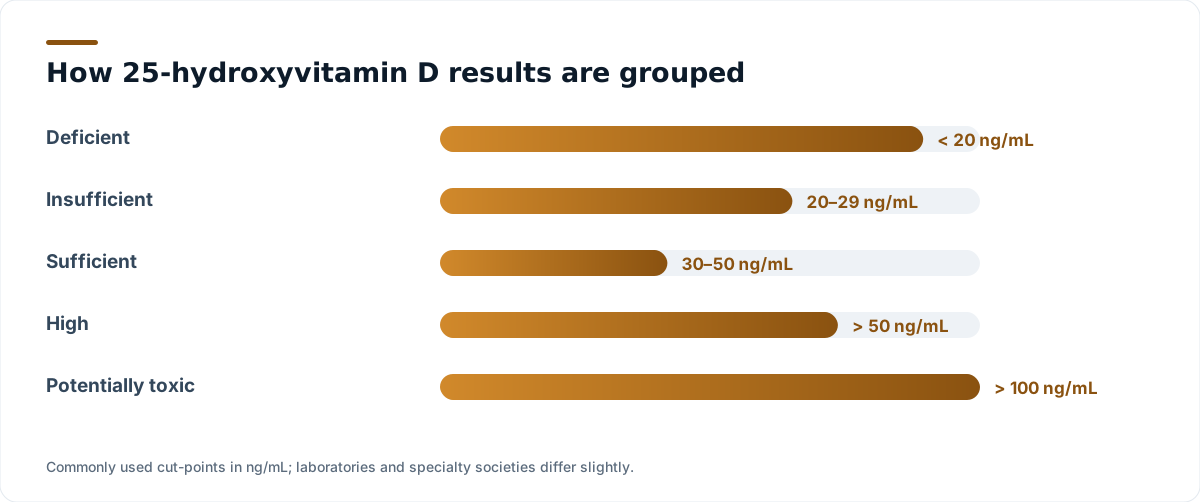
- Most laboratories flag below 20 ng/mL as deficient and 20–29 ng/mL as insufficient, though expert bodies disagree about where "enough" begins.
- Very high doses do not produce extra benefit and can cause harm through hypercalcaemia.
Vitamin D testing became one of the most-ordered laboratory tests in the United States over roughly a decade, driven by observational studies linking low levels to nearly every chronic disease anyone thought to look at. Then the randomized trials arrived, and most of those associations did not translate into benefit from supplementation. The result is a test that is genuinely valuable for a defined group of people and largely unnecessary for everyone else.
What vitamin D actually does
Vitamin D is not really a vitamin. It is a prohormone, synthesised in skin when ultraviolet B radiation converts 7-dehydrocholesterol, then hydroxylated in the liver to 25-hydroxyvitamin D — the storage form we measure — and finally activated in the kidney to 1,25-dihydroxyvitamin D.
Its best-established job is calcium and phosphate regulation. Without adequate vitamin D, calcium absorption from the gut falls, parathyroid hormone rises to pull calcium out of bone, and bone mineralisation suffers. Severe, prolonged deficiency causes rickets in children and osteomalacia in adults — real, painful, and now uncommon in the United States but not extinct.
Beyond bone, vitamin D receptors appear throughout the body, which is why the observational literature is so vast. Muscle function and falls, immune regulation, cardiovascular disease, cancer, depression, diabetes and autoimmune conditions have all been studied. The large randomized trials of the last decade, including VITAL with more than 25,000 participants, largely failed to show that supplementing people who were not deficient reduced cancer, cardiovascular events or fractures. This does not mean vitamin D is unimportant. It means that correcting deficiency matters and that topping up sufficiency does not.
Which test, and what the number means
Ask for 25-hydroxyvitamin D, sometimes written 25(OH)D or calcidiol. It reflects total body stores and has a half-life of two to three weeks. The active form, 1,25-dihydroxyvitamin D, is tightly regulated and can be normal or even high in deficiency, so ordering it for screening is misleading. It has its own narrow uses — hypercalcaemia workup, granulomatous disease, certain kidney conditions.
The units matter. American laboratories generally report ng/mL; many other countries report nmol/L. To convert, multiply ng/mL by 2.5.
| 25(OH)D level | Common label | Typical interpretation |
|---|---|---|
| Below 12 ng/mL | Severe deficiency | Risk of rickets/osteomalacia; treatment indicated |
| 12–19 ng/mL | Deficient | Inadequate for bone health in most people |
| 20–29 ng/mL | Insufficient | Adequate for many; some bodies advise higher |
| 30–50 ng/mL | Sufficient | Target range used by several specialty societies |
| Above 50 ng/mL | High | No added benefit demonstrated |
| Above 100 ng/mL | Potentially toxic | Risk of hypercalcaemia; investigate supplement dose |
The disagreement between 20 and 30 ng/mL is not pedantry. The National Academy of Medicine concluded that 20 ng/mL meets the needs of nearly all healthy people, while the Endocrine Society has used 30 ng/mL as its threshold for people with conditions affecting bone. Which framework your laboratory uses determines whether your report says "insufficient" — which is one reason a mildly low number causes more alarm than it should.
Who should actually be tested
The USPSTF has repeatedly concluded that evidence is insufficient to recommend screening asymptomatic adults in the general population. That is not an argument against testing people with a reason. Testing is reasonable when any of the following applies:
- Osteoporosis, osteopenia or a fragility fracture — see our bone density guide
- Malabsorption: coeliac disease, Crohn's disease, cystic fibrosis, chronic pancreatitis, or after bariatric surgery
- Chronic kidney or liver disease, which impair hydroxylation
- Hyperparathyroidism or unexplained hypercalcaemia
- Medications that accelerate vitamin D metabolism: certain anticonvulsants, glucocorticoids, some antiretrovirals, and antifungals
- Very limited sun exposure: housebound or institutionalised individuals, those who cover most skin for cultural or medical reasons, and night-shift workers
- Darker skin at higher latitudes, where more melanin means less cutaneous synthesis per unit of sunlight
- Obesity, where vitamin D distributes into adipose tissue and serum levels run lower
- Unexplained bone pain, proximal muscle weakness or recurrent falls
A note on race-based reference ranges
Black Americans on average have lower total 25(OH)D but also lower vitamin D binding protein, and generally have higher bone density and lower fracture rates than white Americans. Total 25(OH)D may therefore overstate functional deficiency in this group. This is an active research question and a good reason to interpret a mildly low number in clinical context rather than in isolation.
What deficiency feels like — and does not
Mild insufficiency usually feels like nothing. Genuine deficiency can produce bone pain, particularly in the ribs, pelvis and legs; proximal muscle weakness that makes stairs and rising from a chair harder; and, in children, the skeletal changes of rickets.
Fatigue, low mood, general aches and brain fog are frequently attributed to low vitamin D. These symptoms are real, but they are also enormously non-specific, and randomized trials of supplementation for mood and fatigue in people who are not deficient have generally been disappointing. A low vitamin D level in someone with these symptoms is worth correcting, but it should not stop the search for other causes — anaemia and thyroid dysfunction being two common ones worth ruling out with a CBC and a TSH.
Getting enough
Sunlight
Cutaneous synthesis is efficient but variable. Latitude, season, time of day, skin pigmentation, age and cloud cover all matter. Above roughly 37 degrees north — a line running near San Francisco, Denver, St. Louis and Richmond — winter sunlight produces little or no vitamin D. Deliberately seeking unprotected sun for vitamin D is a poor trade against skin cancer risk, as our skin cancer guide explains.
Food
Few foods contain much naturally. Fatty fish — salmon, mackerel, sardines, herring — are the best sources. Cod liver oil is dense. Egg yolks and UV-exposed mushrooms contribute modestly. In the United States, most milk is fortified, as are many cereals, plant milks, orange juices and yoghurts. Fortification is the reason average intake is not lower than it is.
Supplements
Current U.S. Recommended Dietary Allowances are 600 IU daily for most adults and 800 IU from age 71, with a tolerable upper intake level of 4,000 IU per day for adults. Vitamin D3 (cholecalciferol) raises and maintains levels somewhat more effectively than D2 (ergocalciferol). Because it is fat-soluble, taking it with a meal containing fat improves absorption.
Treatment of documented deficiency typically involves higher doses for eight to twelve weeks followed by a maintenance dose, with a repeat level about three months later — no sooner, since it takes that long to reach a new steady state.
More is not better
Vitamin D toxicity is uncommon but real, and it comes from supplements rather than sun or food. Very high intakes over time can raise blood calcium, producing nausea, vomiting, weakness, frequent urination, confusion, kidney stones and kidney damage. Some trials of very high intermittent dosing in older adults found more falls and fractures, not fewer. Mega-dose products sold online are the main hazard.
Practical guidance
- If you have no risk factors and no symptoms, you probably do not need the test. A modest daily supplement in winter is inexpensive and low risk.
- If you do have a reason to test, ask specifically for 25-hydroxyvitamin D.
- Record the number and the units. Comparing 30 ng/mL with 75 nmol/L without converting is a common source of confusion.
- If deficient, correct it, then recheck at about three months.
- Do not repeat the test every few months once you are stable. Annual or less is plenty for most people on maintenance dosing.
- Tell your clinician every supplement you take, including multivitamins — doubling up is easy.
The bottom line
Vitamin D matters most for bone, and correcting real deficiency is worth doing. What the evidence does not support is testing everyone, treating sufficiency as a disease, or expecting a supplement to fix problems it was never shown to fix. Test with a reason, treat what you find, and resist the temptation to chase a higher number.