
Key takeaways
- A CBC measures the three cell lines in blood — white cells, red cells and platelets — plus indices that describe their size and content.
- It is not a general "cancer screen", but it does frequently provide the first clue to anaemia, infection, bleeding disorders and blood cancers.
- Reference ranges vary between laboratories and differ by sex, age, altitude and pregnancy. Compare a result to its own lab's range.
- MCV — average red cell size — is the single most useful number for narrowing down the cause of anaemia.
- Iron-deficiency anaemia in an adult male or a postmenopausal woman is a gastrointestinal red flag until proven otherwise.
The complete blood count is the most frequently ordered laboratory test in the world. It costs very little, requires one small tube of blood, and reports on three completely different biological systems at once. It is also, for most patients, an impenetrable grid of abbreviations. Here is how to read yours.
What a CBC measures
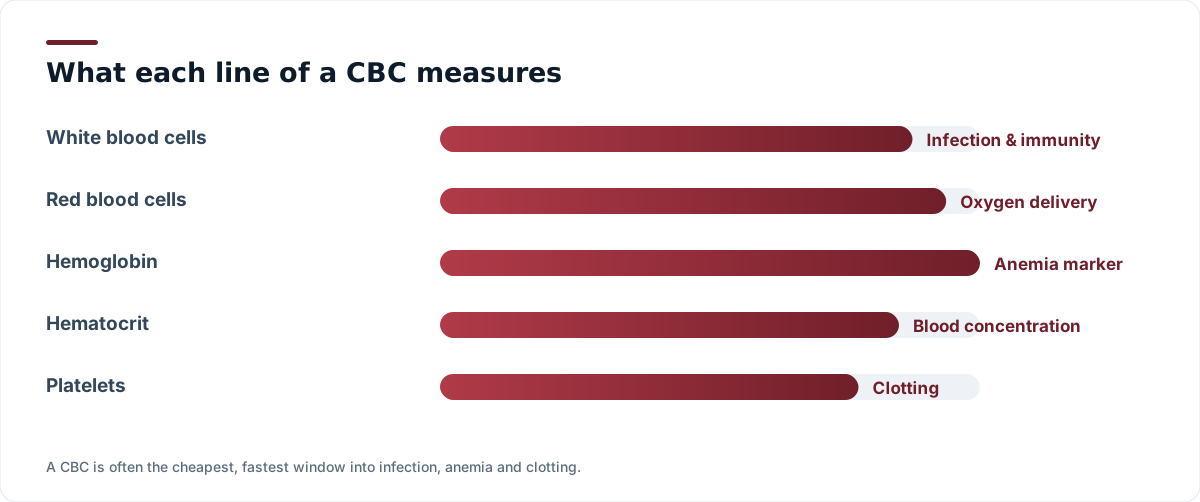
Blood contains plasma and three families of cells, all produced in bone marrow. A CBC counts each family and describes their characteristics. A "CBC with differential" additionally breaks the white cells into their subtypes, which is where much of the diagnostic value sits.
Red blood cells and the anaemia question
Red cells carry oxygen using haemoglobin, an iron-containing protein. Three headline numbers describe them:
- RBC — the count of red cells per volume.
- Haemoglobin (Hgb) — grams of haemoglobin per decilitre. Typical adult ranges run roughly 13.5–17.5 g/dL for men and 12.0–15.5 g/dL for women.
- Haematocrit (Hct) — the percentage of blood volume occupied by red cells, usually about three times the haemoglobin.
Low haemoglobin means anaemia. But anaemia is a finding, not a diagnosis, and the next step is always to ask why. That is where the red cell indices earn their keep.
MCV: the most useful number on the report
Mean corpuscular volume is the average size of your red cells, typically 80–100 femtolitres. It sorts anaemia into three families:
| MCV | Category | Common causes |
|---|---|---|
| Below 80 fL | Microcytic | Iron deficiency, thalassaemia trait, anaemia of chronic disease, lead exposure |
| 80–100 fL | Normocytic | Acute blood loss, chronic kidney disease, chronic inflammation, early iron deficiency, haemolysis |
| Above 100 fL | Macrocytic | Vitamin B12 or folate deficiency, alcohol use, liver disease, hypothyroidism, certain medications, myelodysplasia |
Two supporting numbers refine this. MCH and MCHC describe haemoglobin content per cell. RDW — red cell distribution width — measures how variable cell sizes are; a high RDW with a low MCV points toward iron deficiency rather than thalassaemia trait, where cells are uniformly small.
The red flag worth knowing
New iron-deficiency anaemia in an adult man, or in a woman past menopause, should trigger investigation of the gastrointestinal tract. Slow, invisible blood loss from a colon lesion is a leading cause, and this pattern is one of the more common ways colorectal cancer is first detected. Our colorectal screening guide covers the follow-up.
Reticulocytes
Not on a standard CBC but often added. Reticulocytes are newly released immature red cells, and the count tells you whether the marrow is responding. Anaemia with a high reticulocyte count suggests blood loss or destruction; with a low count it suggests a production problem.
White blood cells and the differential
The total white blood cell count typically runs 4,500–11,000 per microlitre. The differential matters more than the total.
- Neutrophils (about 40–70%). The front line against bacterial infection. High counts occur with bacterial infection, inflammation, physical stress, corticosteroids and smoking. Very low counts — neutropenia — raise real infection risk and are a common consequence of chemotherapy. Notably, a benign lower baseline neutrophil count is common in people of African ancestry and does not indicate disease.
- Lymphocytes (about 20–40%). Viral infections typically raise them. Chronic lymphocytic leukaemia often presents as a persistently and progressively high lymphocyte count in an otherwise well older adult.
- Monocytes (about 2–8%). Rise in chronic infections, recovery phases and some inflammatory conditions.
- Eosinophils (about 1–4%). Allergy, asthma, drug reactions and parasitic infection.
- Basophils (under 2%). Rarely informative alone; persistent elevation can accompany certain myeloproliferative disorders.
A "left shift" — increased immature neutrophils, or bands — suggests the marrow is being pushed hard, classically by significant bacterial infection.
When a white count needs urgent attention
A very high or very low white count, particularly with fever, or a differential showing blast cells, needs prompt evaluation. Blasts are immature precursor cells that should not circulate; their presence requires urgent haematology assessment.
Platelets
Platelets initiate clotting. The typical range is roughly 150,000–450,000 per microlitre.
Low platelets (thrombocytopenia) can result from immune destruction, viral infection, liver disease and portal hypertension, medications including heparin, alcohol, pregnancy, or marrow disorders. Spontaneous bleeding risk generally becomes significant well below 50,000, and serious below 20,000. One common artefact worth knowing: clumping in the collection tube can produce a spuriously low result, which is why an unexpectedly low platelet count is often repeated in a different tube.
High platelets (thrombocytosis) are most often reactive — to iron deficiency, infection, inflammation, recent surgery or removal of the spleen. Persistently high counts without an obvious cause raise the question of a myeloproliferative disorder.
MPV — mean platelet volume — describes average platelet size; larger platelets often indicate rapid production.
When a CBC is ordered
- As part of a general evaluation of fatigue, weakness or pallor
- With fever or suspected infection
- Before surgery
- To monitor medications that suppress marrow, including chemotherapy and some immunosuppressants
- In pregnancy
- To follow known anaemia, kidney disease, liver disease or blood disorders
- With unexplained bruising, bleeding or recurrent infections
It is not, strictly speaking, a screening test recommended for all healthy adults on a schedule, though it is frequently included in routine panels and often reveals something worth pursuing.
How to interpret your own report sensibly
- Use the lab's own reference range. Ranges differ between laboratories and are typically set so that 5% of healthy people fall outside them. Being slightly out of range is common and often meaningless.
- Look at the trend. A haemoglobin of 13.2 is unremarkable — unless yours was 15.4 six months ago.
- Consider context. Dehydration concentrates blood and raises haematocrit; pregnancy dilutes it. Altitude raises red cell counts. Acute illness moves white counts.
- One abnormality is a question, several are a pattern. All three cell lines low together — pancytopenia — is a different and more serious finding than any one line being low alone.
- Ask what the next test is. Low MCV usually means iron studies. High MCV usually means B12 and folate. High white count with a left shift usually means finding the infection.
What a CBC cannot tell you
It does not measure cholesterol, glucose, kidney function, liver enzymes, electrolytes, thyroid hormones or clotting times — those come from other panels. It does not detect most solid tumours. It does not diagnose iron deficiency on its own; ferritin and other iron studies do that. And a completely normal CBC does not exclude serious disease.
The bottom line
The CBC is a remarkably efficient instrument: one tube, three systems, a dozen useful numbers. Read it by cell line, pay particular attention to MCV when haemoglobin is low, treat the differential as more informative than the white cell total, and always compare today's result with your own previous ones rather than with a number you found online.