Key takeaways
- Standard risk calculators estimate probability. A coronary artery calcium scan looks at whether plaque is actually there.
- A CAC score of zero in an intermediate-risk adult is strongly reassuring and often justifies deferring medication.
- Lipoprotein(a) is largely genetically determined, is not measured on a standard lipid panel, and warrants at least one lifetime measurement.
- Apolipoprotein B counts atherogenic particles and can reveal risk hidden by a normal-looking LDL.
- These tests refine decisions in the grey zone. They do not replace blood pressure control, lipid management or not smoking.
Heart disease remains the leading cause of death in the United States, and its most common first symptom in men is a heart attack. That is an uncomfortable fact about a disease that develops silently over decades. The tests in this guide exist to shrink that silence — to move from a statistical estimate of your risk toward a direct measurement of what is happening inside your arteries.
Start with the basics, not the exotic tests
Before anything below, four things do most of the work: knowing your blood pressure, knowing your lipids, knowing your blood sugar, and not smoking. Our guides to blood pressure, the lipid panel and A1C testing cover those. Advanced testing is for when those basics leave the decision genuinely uncertain.
The risk estimate, and why it is not enough
American practice starts with a pooled risk equation combining age, sex, race, total and HDL cholesterol, systolic blood pressure, blood pressure treatment, diabetes and smoking status to estimate the probability of a cardiovascular event over ten years. Newer equations have refined this, incorporating kidney function and metabolic factors.
These tools are useful and imperfect. They are heavily weighted by age, which means a 45-year-old with meaningful plaque can score "low" while a healthy 68-year-old with clean arteries scores "intermediate". They also do not capture family history, lipoprotein(a) or inflammatory disease.
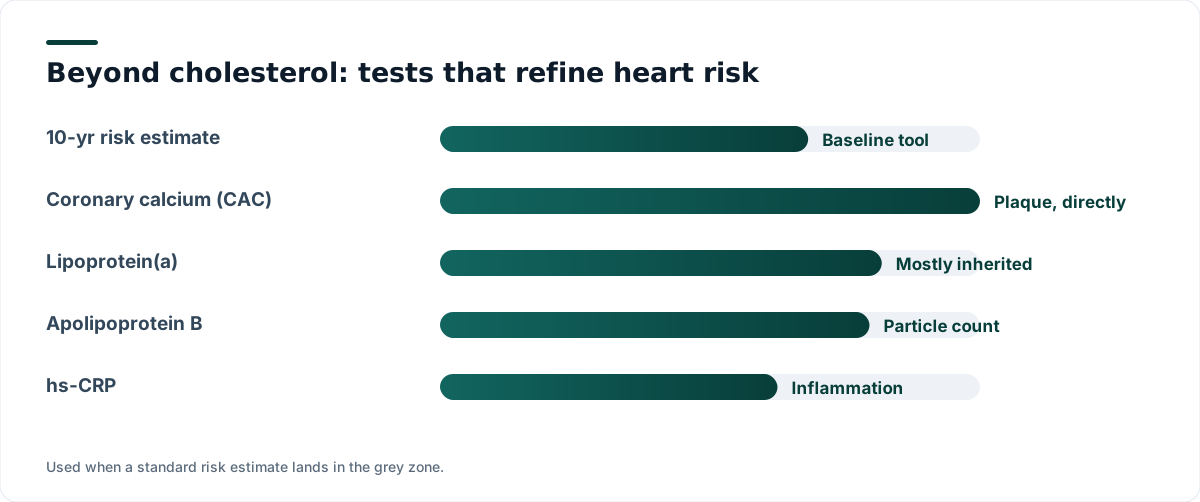
The clinically awkward zone is an estimated 10-year risk between roughly 5% and 20%. That is where additional testing changes decisions.
Coronary artery calcium scanning
A CAC scan is a fast, non-contrast CT of the heart, typically taking ten to fifteen minutes with the scan itself lasting seconds. It quantifies calcified plaque in the coronary arteries and produces an Agatston score.
The logic is simple. Atherosclerotic plaque calcifies as it matures. Calcium in a coronary artery is therefore direct evidence that atherosclerosis exists, and the amount correlates with total plaque burden and with future event risk.
| CAC score | Interpretation | Typical implication |
|---|---|---|
| 0 | No detectable calcified plaque | Very low short-term risk; statin often deferred in intermediate-risk adults |
| 1–99 | Mild plaque | Risk-factor treatment usually favoured |
| 100–299 | Moderate plaque | Statin therapy generally indicated |
| 300 or more | Extensive plaque | Treated similarly to established disease in many protocols |
The "power of zero" is the most useful application. In an intermediate-risk adult, a score of zero is associated with a low event rate over the following several years and can reasonably justify holding off on medication and rechecking in five to ten years.
Important caveats
- CAC detects calcified plaque. Soft, non-calcified plaque — more typical in younger adults — is invisible to it. A zero score in a 38-year-old is less reassuring than in a 62-year-old.
- It involves a small radiation dose, roughly comparable to a mammogram.
- It is not useful in people already on a statin for established disease, or in anyone whose treatment would not change.
- Coverage varies. Many people pay out of pocket, typically a modest amount, though an increasing number of insurers now cover it for appropriate indications.
- It is not recommended for adults at low risk, or for those already at high risk who should be treated regardless.
Lipoprotein(a)
Lipoprotein(a), written Lp(a), is an LDL-like particle with an additional protein attached. Its blood level is roughly 80–90% genetically determined, largely fixed through life, and essentially unaffected by diet, exercise or statins. Elevated Lp(a) is an independent causal risk factor for heart attack, stroke and aortic valve stenosis.
Roughly one in five people worldwide has an elevated level. It is not included in a standard lipid panel, so almost all of them do not know.
The current consensus among lipid specialists is that every adult should have Lp(a) measured at least once in a lifetime. It is particularly important with a family history of premature cardiovascular disease, personal cardiovascular disease at a young age, familial hypercholesterolemia, recurrent events despite well-controlled LDL, or unexplained aortic stenosis.
Since no approved therapy specifically lowers Lp(a) yet — several are in late-stage trials — the practical response to a high level is to treat every other modifiable risk factor more aggressively, and to consider cascade testing of relatives.
Apolipoprotein B
Every atherogenic lipoprotein particle carries exactly one ApoB molecule. Measuring ApoB therefore counts particles, whereas LDL cholesterol measures the cholesterol cargo those particles carry.
This distinction matters when the two diverge. People with insulin resistance, high triglycerides or metabolic syndrome often carry many small, cholesterol-poor LDL particles. Their LDL cholesterol can look acceptable while their particle count — and their risk — is high. This is called discordance, and ApoB resolves it.
ApoB does not require fasting and is increasingly recommended as a secondary target, particularly in people with triglycerides above 200 mg/dL, diabetes, obesity or very low LDL levels.
High-sensitivity C-reactive protein
hs-CRP measures low-grade systemic inflammation. Below 1 mg/L is considered low risk, 1–3 mg/L average, and above 3 mg/L higher risk. It is a genuine risk marker, but it is non-specific — infection, injury, obesity, smoking and autoimmune disease all raise it — and its role has narrowed as other tools improved. Its main current use is as a risk-enhancing factor when the decision is borderline, and it should be measured when you are well, not during or shortly after an illness.
Other tests you may be offered
- Carotid intima-media thickness ultrasound. Once popular, now less used for risk stratification because CAC outperforms it.
- Ankle-brachial index. Compares blood pressure at the ankle and arm, screening for peripheral artery disease. Useful in older adults, smokers and people with diabetes.
- Coronary CT angiography. Uses contrast and shows both calcified and soft plaque plus degree of narrowing. It is a diagnostic test for people with symptoms rather than a screening test for those without.
- Exercise stress testing. Not recommended for screening asymptomatic low-risk adults; it produces false positives and downstream testing without clear benefit.
- Polygenic risk scores. Increasingly available commercially, still evolving in clinical utility, and best interpreted with genetic counselling.
Who actually benefits from advanced testing
Consider going beyond the basics if you:
- Have an estimated 10-year risk between about 5% and 20% and are undecided about starting a statin
- Have a strong family history of early heart disease not explained by your measured risk factors
- Have metabolic syndrome, high triglycerides or an autoimmune inflammatory condition
- Are reluctant to take medication and want more information before deciding
- Have had an event despite an apparently reassuring lipid panel
You probably do not need them if you already have established cardiovascular disease, diabetes with other risk factors, an LDL of 190 mg/dL or above, or a clearly low risk profile in your thirties with no family history — in each case the treatment decision is already made.
Symptoms are not a testing question
Chest pressure, tightness, or pain with exertion; unusual breathlessness; jaw, neck, back or arm discomfort; nausea with sweating; or sudden severe fatigue require immediate medical evaluation. Women, older adults and people with diabetes more often present without classic chest pain. Call 911 rather than scheduling a scan.
The bottom line
Risk calculators tell you what happens on average to people who look like you on paper. Calcium scoring tells you what is happening in your arteries. Lp(a) tells you what you inherited. ApoB tells you how many particles are actually circulating. Used selectively, in the grey zone, these tests turn a coin flip into an informed decision — which is exactly what they are for.