Key takeaways
- Annual low-dose CT is recommended for adults aged 50 to 80 with a 20 pack-year smoking history who currently smoke or quit within the past 15 years.
- Screening reduced lung cancer deaths by around 20–24% in the major randomized trials.
- Only a small single-digit percentage of eligible Americans are screened, making this the most underused major cancer screening test in the country.
- Most nodules found are benign. A structured reporting system, Lung-RADS, determines what happens next.
- Screening is not a substitute for quitting. Combining the two produces far more benefit than either alone.
Lung cancer kills more Americans than colorectal, breast and prostate cancers combined. Historically, most cases were found late, when cure was rarely possible. Annual low-dose CT screening changed that arithmetic — and yet, more than a decade after the evidence arrived, the great majority of eligible Americans have never had the scan. This is the widest gap between proven benefit and actual use in preventive oncology.
The evidence
Two large randomized trials underpin current practice. The U.S. National Lung Screening Trial randomized more than 53,000 high-risk participants to annual low-dose CT or chest X-ray and found a roughly 20% reduction in lung cancer mortality in the CT arm. The European NELSON trial, using a volume-based nodule management protocol, reported a comparable reduction, with a larger effect among women.
Crucially, chest X-ray does not work for screening. Earlier trials showed no mortality benefit, which is why "I had a chest X-ray last year" is not a substitute.
Who qualifies
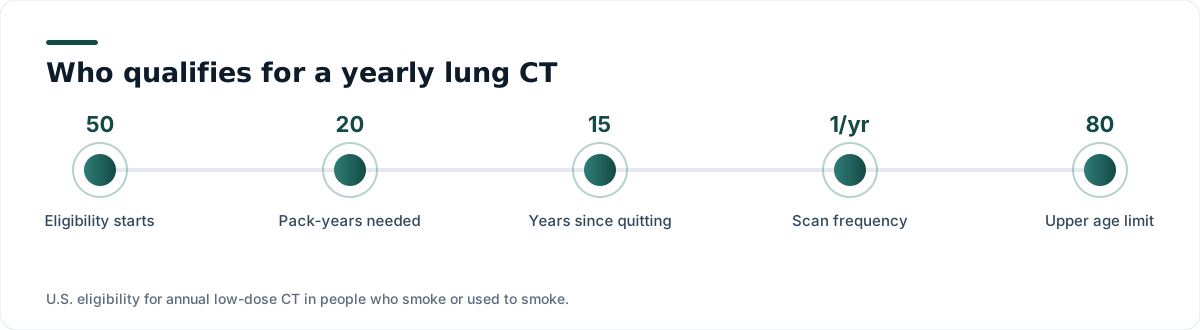
The U.S. Preventive Services Task Force recommends annual screening with low-dose CT for adults who meet all of the following:
- Age 50 to 80
- A smoking history of at least 20 pack-years
- Currently smoke, or quit within the past 15 years
The 2021 update lowered the starting age from 55 and the threshold from 30 pack-years, roughly doubling the eligible population and — importantly — improving eligibility for Black Americans and for women, who develop lung cancer at lower cumulative exposures and were disproportionately excluded by the earlier criteria.
Calculating pack-years
Pack-years = packs smoked per day × years smoked. One pack a day for 20 years is 20 pack-years. Half a pack a day for 40 years is also 20. Two packs a day for 10 years is 20 as well. Add up periods of different intensity separately. Many people underestimate their total because they think only of their heaviest years.
Screening should stop once a person has not smoked for 15 years, or develops a health problem that would substantially limit life expectancy or the willingness or ability to undergo curative lung surgery. That last criterion is not a formality: screening only helps if a cancer found could actually be treated.
What the scan involves
You lie on a table that passes through a CT scanner, hold your breath for a few seconds, and it is done — typically under five minutes in the room, with no contrast injection and no fasting. Radiation dose is roughly a quarter to a fifth of a standard chest CT, comparable to a few months of natural background radiation.
Medicare and most private plans cover the scan for eligible people without cost sharing, provided the facility meets accreditation and registry requirements. Medicare additionally requires a counselling and shared decision-making visit before the first scan.
Understanding your result: Lung-RADS
Radiologists report screening CTs using Lung-RADS, a structured system that ties each finding to a recommended action. This standardisation matters because the majority of first scans find at least one nodule, and the overwhelming majority of those nodules are benign — old infections, scars, or harmless clusters of tissue.
| Category | Meaning | Usual next step |
|---|---|---|
| 1 — Negative | No nodules | Continue annual screening |
| 2 — Benign appearance | Findings with very low cancer probability | Continue annual screening |
| 3 — Probably benign | Low probability of cancer | Repeat CT in about 6 months |
| 4A — Suspicious | Moderate probability | CT in 3 months, or PET/CT |
| 4B / 4X — More suspicious | Higher probability | Further imaging, PET/CT, tissue sampling |
| S — Other significant finding | Incidental non-lung finding | Evaluate on its own merits |
That last category deserves attention. Lung CT frequently reveals coronary artery calcification, emphysema, thyroid nodules, adrenal lesions and aortic changes. Some of these are genuinely useful — visible coronary calcium is a real cardiovascular signal, discussed in our heart risk guide. Others generate anxiety and additional testing for findings that would never have mattered.
The honest downsides
- False positives. Common on the first scan. Most are resolved by follow-up imaging rather than by biopsy, and Lung-RADS was designed specifically to reduce unnecessary intervention.
- Invasive procedures for benign disease. A minority of participants undergo biopsy or surgery for what turns out not to be cancer. Complication rates are low but not zero.
- Radiation. Cumulative over years of annual scanning, though modelling consistently shows benefit outweighing risk in the eligible population.
- Overdiagnosis. Some screen-detected cancers would not have caused harm in that person's lifetime. Estimates are lower than for some other cancers but not negligible.
- Anxiety. Waiting three or six months for a repeat scan is genuinely stressful, and programs should support people through it.
Screening is not a licence to keep smoking
A normal scan does not make smoking safe. Smoking also causes heart disease, stroke, COPD, and cancers of the bladder, kidney, pancreas, oesophagus, larynx, cervix and more. Screening programs are required to offer cessation support precisely because the combination is what saves lives. Quitting at any age improves life expectancy, and the benefits begin within weeks.
Why so few people get screened
Uptake among eligible Americans has remained in the low single digits to low teens depending on the state, far behind mammography or colonoscopy. Several reasons recur:
- Awareness. Many eligible people, and some clinicians, simply do not know the test exists.
- Stigma. Lung cancer carries a blame narrative that other cancers do not, and shame keeps people away from a conversation about smoking history.
- Access. Accredited screening centres are unevenly distributed, with rural gaps.
- Fatalism. A belief that lung cancer is a death sentence regardless — which was closer to true before screening and modern therapy, and is much less true now.
- Administrative friction. Documentation of smoking history and the shared decision-making visit add steps that get dropped.
Symptoms that need evaluation now
Screening is for people without symptoms. See a clinician promptly for a cough lasting more than a few weeks or a change in a chronic cough, coughing blood, chest pain worsened by breathing or coughing, hoarseness, unexplained weight loss, shortness of breath, recurrent chest infections, or new bone pain. These require diagnostic evaluation, not a screening scan.
Questions worth asking
- Do I meet the eligibility criteria — and can we calculate my pack-years together?
- Is the facility accredited for lung cancer screening?
- What happens if a nodule is found, and who coordinates the follow-up?
- What cessation support is available through the program?
- What will this cost me given my insurance?
The bottom line
Annual low-dose CT is a proven, quick, well-covered test that meaningfully reduces death from the deadliest cancer in the United States — and almost nobody who qualifies is getting it. If you are between 50 and 80 and have smoked the equivalent of a pack a day for twenty years, the most valuable ten minutes you can spend this year is calculating your pack-years and asking your clinician whether you are eligible.