Key takeaways
- Most sexually transmitted infections cause no symptoms, which is precisely why screening rather than waiting is the strategy.
- The CDC recommends at least one HIV test for everyone aged 13 to 64, and hepatitis C testing at least once in adulthood.
- Annual chlamydia and gonorrhoea screening is recommended for sexually active women under 25 and for older women with risk factors.
- Syphilis has risen sharply in the United States, including congenital cases — testing in pregnancy is essential.
- Testing is widely available free or low cost through health departments, and at-home collection kits have expanded access considerably.
Sexually transmitted infections are among the most common reportable conditions in the United States, with millions of new infections each year. They are also among the most treatable — and the most silent. Chlamydia, the most frequently reported bacterial STI in the country, produces no symptoms in the majority of people who have it, which means that the only way most infections are found is by deliberately looking.
Why screening beats waiting for symptoms
Untreated infections do not simply persist quietly. Chlamydia and gonorrhoea can ascend to cause pelvic inflammatory disease, which is a leading preventable cause of infertility, chronic pelvic pain and ectopic pregnancy. Untreated syphilis progresses through stages and can eventually affect the brain, nerves, eyes and cardiovascular system, and in pregnancy it causes stillbirth and severe congenital disease. HIV diagnosed late means worse outcomes and more onward transmission; diagnosed early and treated, it now carries a near-normal life expectancy and, at an undetectable viral load, cannot be sexually transmitted. Hepatitis C is curable with a short oral course, but only if it is found.
Every one of those outcomes is preventable by a test that usually involves urine, a swab, or a blood draw.
Who should be tested for what
Everyone
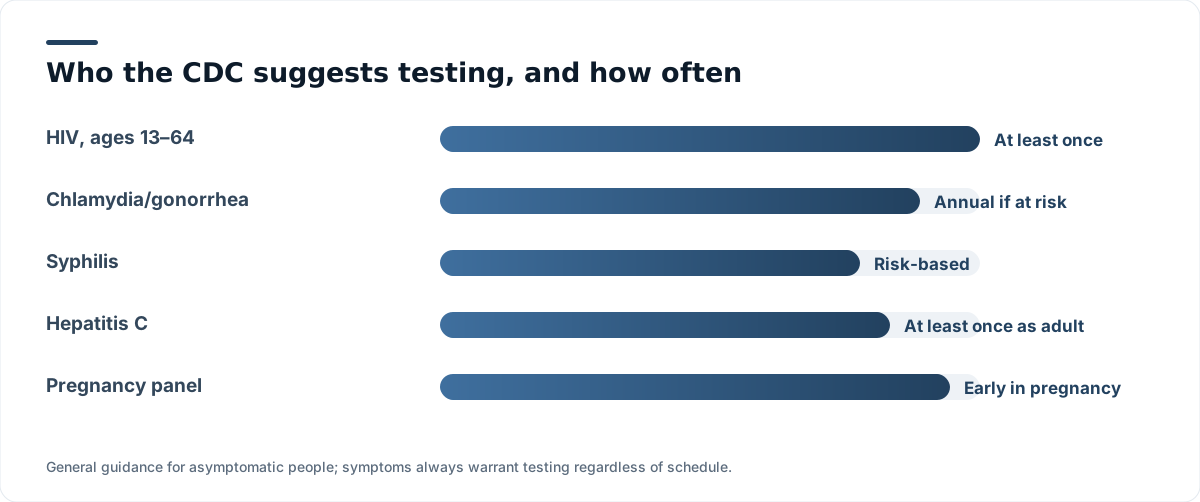
- HIV at least once between ages 13 and 64, as part of routine care. More frequent testing — at least annually — for anyone with ongoing risk.
- Hepatitis C at least once in adulthood, and in every pregnancy.
- Hepatitis B screening is now recommended at least once for all adults.
Women and people with a cervix
- Chlamydia and gonorrhoea annually if sexually active and under 25; at 25 and older if there are risk factors such as a new partner, multiple partners, a partner with an STI, or inconsistent condom use.
- Cervical cancer screening from 21, which detects the consequences of high-risk HPV rather than the infection itself. Self-collection options for HPV testing have expanded U.S. access.
- In pregnancy: HIV, syphilis and hepatitis B at the first visit; hepatitis C; chlamydia and gonorrhoea if under 25 or at risk; and repeat syphilis testing in the third trimester and at delivery in areas with high rates.
Men who have sex with men
- At least annual testing for HIV, syphilis, chlamydia and gonorrhoea, with site-specific testing — throat and rectal swabs as well as urine, since a urine test alone misses a large share of infections.
- Every three to six months with multiple or anonymous partners.
- Discussion of PrEP, which requires HIV testing at initiation and regularly thereafter.
Men who have sex with women
Routine chlamydia and gonorrhoea screening in this group is not universally recommended, mainly on cost-effectiveness grounds rather than because infection is rare. Testing is appropriate with symptoms, a partner diagnosed with an STI, a new or multiple partners, or in high-prevalence settings.
People taking PrEP
Pre-exposure prophylaxis for HIV requires HIV testing before starting and roughly every three months while continuing, along with kidney function monitoring and regular bacterial STI screening. That visit schedule is one of the more reliable routes into consistent sexual health care in the U.S.
What the tests involve
| Infection | Sample | Notes |
|---|---|---|
| Chlamydia / gonorrhoea | Urine, vaginal, rectal or throat swab | NAAT is the standard; site-specific testing matters |
| HIV | Blood or oral fluid | Fourth-generation antigen/antibody tests detect infection earlier |
| Syphilis | Blood | Screening test confirmed by a second, different test |
| Hepatitis B and C | Blood | Hepatitis C antibody followed by RNA if positive |
| Trichomoniasis | Vaginal swab or urine | Common and easily treated; often overlooked |
| Herpes (HSV) | Swab of a lesion; blood for antibodies | Routine blood screening in people without symptoms is not recommended |
| HPV | Cervical sample or self-collected swab | Part of cervical cancer screening, not general STI panels |
The herpes line surprises people. The CDC advises against routine type-specific serologic screening in asymptomatic adults, because the tests have meaningful false positive rates, a positive result rarely changes management, and the psychological impact of a false positive is substantial.
Window periods: why timing matters
Testing too soon after exposure produces false reassurance. Approximate window periods:
- Chlamydia and gonorrhoea: usually detectable within one to two weeks.
- HIV: a fourth-generation lab test typically detects infection within about two to six weeks; rapid antibody tests can take up to three months. A negative test soon after a specific exposure should be repeated.
- Syphilis: usually detectable within three to six weeks, sometimes longer.
- Hepatitis C: antibodies typically appear within eight to eleven weeks; RNA testing detects infection earlier.
After a high-risk exposure
HIV post-exposure prophylaxis must be started within 72 hours of exposure, and sooner is better. If you think you may have been exposed, seek care immediately — an emergency department, urgent care, or a sexual health clinic — rather than waiting for a test result.
Where to get tested
- Primary care. Ask directly; STI screening is often skipped unless raised.
- Local health departments. Frequently free or sliding-scale, and often the fastest route to treatment.
- Planned Parenthood and community health centres. Widely available, income-based fees.
- Federally funded programs. The CDC maintains a searchable directory of testing sites.
- At-home collection kits. You collect the sample and mail it to a laboratory. These have genuinely improved access, particularly in rural areas. Choose a service that uses CLIA-certified laboratories and provides a route to treatment for positives.
Under the ACA, several STI screenings and counselling services are among the preventive services covered without cost sharing on non-grandfathered plans. Confidentiality concerns — such as explanation-of-benefits statements sent to a policyholder — are a real barrier for some people, and public clinics remain an option where privacy matters.
If a test is positive
- Most bacterial STIs are cured with a short course of antibiotics. Chlamydia, gonorrhoea, syphilis and trichomoniasis are all treatable.
- Complete the full course and follow abstinence guidance until you and your partners are treated.
- Tell partners. Health departments offer confidential partner notification, and many states permit expedited partner therapy, where a clinician provides treatment for a partner without a separate visit.
- Retest. Reinfection is common — retesting about three months after treatment for chlamydia or gonorrhoea is standard.
- Get the rest of the panel. One STI raises the likelihood of another.
Prevention beyond testing
- HPV vaccination, routinely recommended at 11 or 12, catch-up through 26, and available with shared decision making through 45. It prevents the great majority of cervical cancers and several other HPV-driven cancers.
- Hepatitis B vaccination, now recommended for all adults aged 19 to 59.
- Condoms, which substantially reduce transmission of most STIs.
- PrEP for HIV, highly effective when taken as prescribed.
- Doxycycline post-exposure prophylaxis, now recommended by the CDC for certain populations to reduce bacterial STI incidence — worth asking about if you are in a group where it applies.
The bottom line
STI screening is fast, mostly painless, frequently free, and prevents outcomes — infertility, congenital syphilis, late HIV diagnosis — that are genuinely serious and entirely avoidable. The main barrier is not access or cost. It is that nobody brings it up. Bringing it up is the whole intervention.