Key takeaways
- Skin cancer is the most commonly diagnosed cancer in the United States — roughly one in five Americans develops it by age 70.
- Basal and squamous cell carcinomas are far more common; melanoma is much rarer but causes most skin cancer deaths.
- The ABCDE rule and the "ugly duckling" sign are the two most useful self-checking tools.
- Melanoma found early and confined to the skin has a five-year relative survival above 99%. Found after distant spread, that figure collapses.
- Sun protection is genuinely preventive: broad-spectrum sunscreen, shade, clothing, and complete avoidance of tanning beds.
More Americans are diagnosed with skin cancer each year than with all other cancers combined. It is also the cancer most visible to the naked eye, which creates an unusual situation: the single best surveillance instrument for the most common cancer in the country is a well-lit bathroom mirror and ten minutes of attention every month.
The three cancers people mean by "skin cancer"
Basal cell carcinoma
By far the most common, accounting for the majority of cases. It arises in the basal layer of the epidermis, usually on sun-exposed skin — face, ears, neck, scalp, shoulders. Typical appearances include a pearly or waxy bump, sometimes with visible small blood vessels, a flat flesh-coloured or brown scar-like lesion, or a sore that bleeds, scabs, heals and returns. Basal cell carcinoma very rarely spreads to distant sites, but it grows locally and can be genuinely destructive if ignored, particularly around the nose, eyes and ears.
Squamous cell carcinoma
The second most common. Often a firm red nodule, a rough scaly patch, or a wart-like growth that crusts and bleeds. It also favours sun-exposed skin, including the lips and ears. Squamous cell carcinoma can spread if neglected, though the great majority are cured with local treatment. Its precursor, actinic keratosis — a rough sandpapery patch on chronically sun-exposed skin — is extremely common and is often treated to prevent progression.
Melanoma
Far less common than the other two but responsible for the substantial majority of skin cancer deaths. Melanoma arises from melanocytes, the pigment-producing cells. It can appear in an existing mole or, more often, as a new lesion on normal skin. It can also occur in places sunlight rarely reaches — under nails, on soles and palms, in the mouth and eyes — a pattern called acral or mucosal melanoma that is proportionally more common in people with darker skin and is frequently diagnosed late.
The ABCDE rule
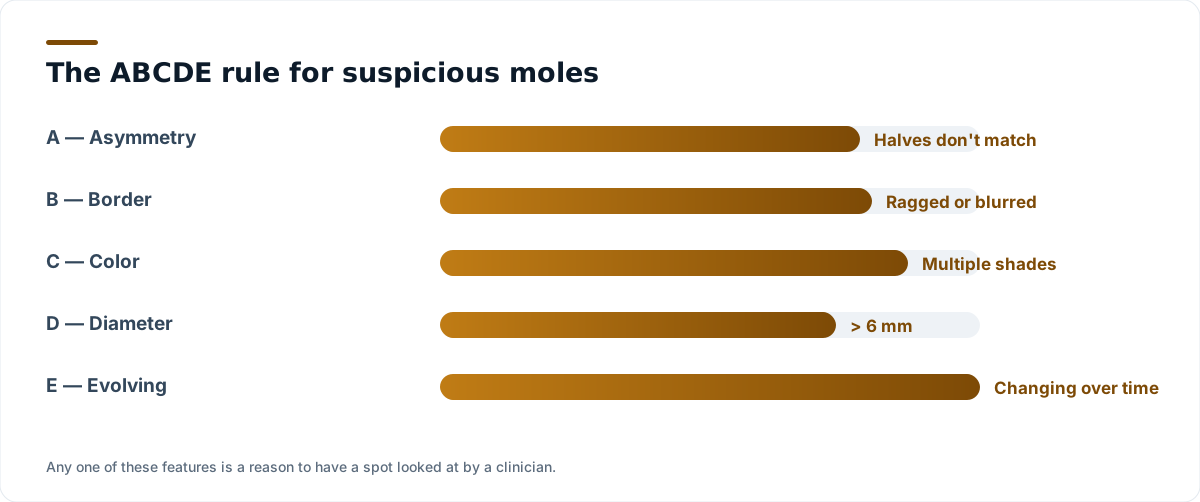
- A — Asymmetry. Draw an imaginary line through the middle. If the halves do not match, that matters.
- B — Border. Ragged, notched, scalloped or blurred edges rather than a clean outline.
- C — Colour. More than one shade — brown, black, tan, and sometimes red, white or blue within a single lesion.
- D — Diameter. Larger than about 6 mm, roughly a pencil eraser. Melanomas can be smaller, so this is a prompt, not a threshold.
- E — Evolving. Any change in size, shape, colour, elevation, or new symptoms such as bleeding, itching or crusting. This is the single most important letter.
The ugly duckling sign
Most people's moles resemble one another. A lesion that plainly looks unlike its neighbours deserves attention even if it does not tick an ABCDE box. Dermatologists find this heuristic at least as useful as the letters.
Do not wait on these
A new dark streak under a fingernail or toenail without injury, a sore that has not healed in a month, a mole that bleeds spontaneously, or a rapidly growing nodule of any colour should be seen promptly. Rapidly growing, firm, dome-shaped lesions can represent nodular melanoma, which lacks the classic ABCDE features and is the most lethal subtype precisely because it is dismissed.
How to do a self-examination properly
Once a month, in good light, after a shower:
- Face the mirror and examine face, ears, neck, chest and abdomen. Women should lift the breasts to check underneath.
- Raise your arms and look at the left and right sides, including underarms.
- Examine forearms, palms, backs of hands, between fingers and under nails.
- Sit down and inspect the front of the thighs, shins, tops of feet, between toes, under toenails.
- Use a hand mirror to check the soles and the backs of the legs.
- Use a hand mirror with the wall mirror for the back, buttocks and genital area.
- Part your hair, or ask someone, to inspect the scalp — a commonly missed site.
Photographing anything uncertain against a ruler or coin gives you a comparison point next month. Change over eight to twelve weeks is far more informative than a single impression.
Professional skin examinations
Here the evidence is genuinely mixed. The U.S. Preventive Services Task Force has concluded that current evidence is insufficient to assess the balance of benefits and harms of routine whole-body skin examination by a clinician in asymptomatic adults — an "I" statement, meaning not enough data, not a recommendation against.
In practice, dermatology organisations recommend periodic professional skin checks, and there is broad agreement that they are worthwhile for people at higher risk:
- A personal history of melanoma or non-melanoma skin cancer
- A first-degree relative with melanoma
- More than roughly 50 moles, or several atypical (dysplastic) moles
- Fair skin that burns easily, red or blond hair, light eyes, freckling
- A history of severe blistering sunburns, especially in childhood
- Any history of indoor tanning
- Immunosuppression, including organ transplant recipients, who have dramatically elevated squamous cell carcinoma risk
- Chronic sun exposure through outdoor work or recreation
Dermatologists use a dermatoscope — a magnifying device with polarised light — which substantially improves accuracy over the naked eye. Some practices offer total body photography for people with many moles, creating a baseline map against which change is easy to spot.
Skin cancer in people with darker skin
Skin cancer is less common in people with more melanin, but it is not rare and it is diagnosed later, with worse outcomes. Melanoma in Black Americans is most often acral — on the palms, soles, or under nails — where nobody thinks to look. Bob Marley's fatal melanoma, which began under a toenail, remains the most-cited example.
The practical implications are specific: check palms, soles, nail beds, and the mouth; do not assume darker skin confers immunity; and be alert to a new or changing pigmented band on a nail.
Prevention that actually works
Sunscreen. Broad-spectrum, SPF 30 or higher, water resistant. Applied generously — most people use a fraction of the tested amount — and reapplied every two hours, or after swimming or heavy sweating. Both mineral filters (zinc oxide, titanium dioxide) and chemical filters are effective; the best sunscreen is the one you will reapply.
Shade and timing. Ultraviolet intensity peaks roughly between 10 a.m. and 4 p.m. Shade is more reliable than any product.
Clothing. Tightly woven fabric, wide-brimmed hats and UV-blocking sunglasses outperform sunscreen because they do not wear off. UPF-rated clothing is a reasonable investment for people who spend long hours outdoors.
No tanning beds. Ever. Indoor tanning is classified as carcinogenic to humans, and use before age 35 is associated with a substantial increase in melanoma risk. There is no safe tanning device.
Sunburn is a warning, not a stage. The idea that burning is a necessary step toward a base tan is false; a tan is itself evidence of DNA damage.
Sunscreen and vitamin D
A common objection is that sun protection causes vitamin D deficiency. Real-world studies of regular sunscreen users generally do not show clinically meaningful deficiency, and dietary sources and supplements address the issue without the cancer risk. Our vitamin D guide covers who genuinely needs testing.
What happens if something is found
A suspicious lesion is biopsied — usually a small in-office procedure with local anaesthetic. Most biopsies are benign. If cancer is confirmed, treatment depends on type, size and location: surgical excision, Mohs micrographic surgery for high-risk facial sites, topical therapies, cryotherapy, curettage, or radiation. Melanoma treatment additionally depends on depth of invasion, measured in millimetres, which is the strongest single predictor of outcome — and which is exactly why a month of hesitation matters.
The bottom line
Skin cancer is the most common cancer in America and among the most survivable when caught early. The habits that make the difference are unglamorous: cover up, skip the tanning bed, look at your own skin once a month, and get anything new, changing or stubbornly unhealed examined rather than watched for another season.