Key takeaways
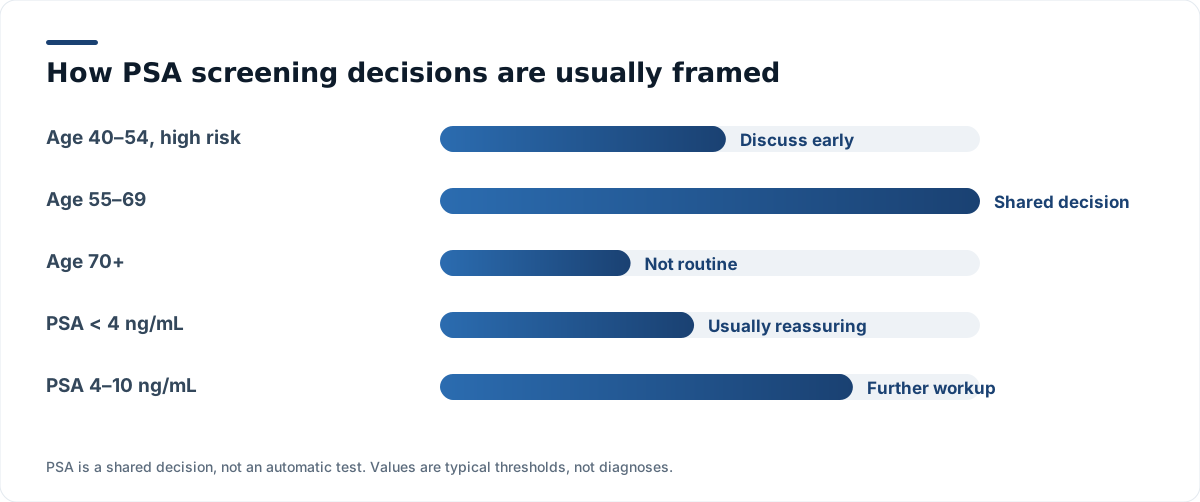
- PSA screening is framed in the U.S. as a shared decision for men aged 55 to 69, not as an automatic annual test.
- Routine PSA screening is not recommended for men 70 and older.
- Higher-risk men — Black men and those with a strong family history or known genetic variants — are commonly advised to start the conversation at 40 to 45.
- An elevated PSA is not a cancer diagnosis. Infection, an enlarged prostate, recent ejaculation and even cycling can raise it.
- MRI before biopsy and active surveillance for low-risk disease have substantially reduced the historical harms of screening.
Prostate cancer is the most commonly diagnosed non-skin cancer in American men and the second leading cause of male cancer death. It is also the screening topic where the medical profession has most visibly changed its mind — twice. Understanding why explains what to do now.
Why this test has been so controversial
PSA — prostate-specific antigen — is a protein made by the prostate. When blood testing became widely available in the late 1980s, PSA screening spread rapidly across the United States. Diagnoses surged. So did treatment: surgery and radiation delivered to enormous numbers of men, many of whom had cancers that would never have troubled them.
Prostate cancer is unusual in that a large share of cases grow so slowly that the man dies of something else first. Autopsy studies find prostate cancer in a substantial proportion of older men who died of unrelated causes. Treating those cancers offers no benefit while carrying real costs — erectile dysfunction and urinary incontinence being the most common.
By 2012, the USPSTF recommended against PSA screening for all men, a D grade. Screening rates fell. Then, over the following years, two things changed. Rates of metastatic prostate cancer at diagnosis began rising. And practice evolved: MRI-guided biopsy reduced the detection of clinically insignificant disease, and active surveillance replaced immediate treatment for low-risk cancers. In 2018 the Task Force revised its position to a C grade for men aged 55 to 69 — meaning the decision should be individual and informed — while maintaining a D grade against routine screening at 70 and above.
The question is no longer "does PSA screening find cancer?" It plainly does. The question is whether finding it, in you, at this age, will do more good than harm.
What PSA actually measures
PSA is produced by prostate tissue, both healthy and cancerous, and liquefies semen. A small amount leaks into the bloodstream normally. More prostate tissue, or disrupted prostate tissue, means more PSA in the blood.
The traditional cut-off of 4.0 ng/mL is a convention, not a biological boundary. Some men with PSA below 4 have significant cancer; many men with PSA above 4 do not. Interpretation therefore uses several refinements:
- Age-specific ranges. The prostate enlarges with age, so what is normal at 50 differs from 70.
- PSA velocity. How fast the value is rising over serial tests, which can matter more than any single number.
- PSA density. PSA relative to prostate volume measured on imaging.
- Free versus total PSA. A lower percentage of free PSA is more suggestive of cancer.
- Secondary biomarkers. Several blood and urine tests can refine risk before committing to biopsy.
Things that raise PSA that are not cancer
- Benign prostatic hyperplasia — ordinary age-related enlargement, the most common cause
- Prostatitis or urinary tract infection, which can raise PSA dramatically
- Ejaculation within 48 hours of the test
- Vigorous cycling shortly beforehand
- Recent catheterisation, cystoscopy or prostate biopsy
- Digital rectal examination performed just before the blood draw
Conversely, 5-alpha-reductase inhibitors such as finasteride and dutasteride roughly halve PSA, so results must be interpreted accordingly.
Who should have the conversation, and when
Men aged 55 to 69 at average risk. This is the group where guidelines converge on shared decision making. Screening in this band reduces prostate cancer deaths modestly and reduces metastatic disease, at the cost of false positives, biopsies and some overtreatment.
Men aged 40 to 54 at higher risk. Several organisations suggest beginning the discussion earlier for:
- Black men, who have roughly double the prostate cancer mortality of white men in the United States and tend to be diagnosed younger
- Men with a father or brother diagnosed with prostate cancer, particularly before 65
- Men with a known BRCA1 or BRCA2 variant, or a family history of Lynch syndrome
- Men with multiple relatives affected by prostate, breast, ovarian or pancreatic cancer
Men 70 and older. Routine screening is not recommended, because the lead time needed to benefit typically exceeds remaining life expectancy. A healthy 72-year-old with a long life expectancy and a personal preference for screening is a legitimate exception to discuss individually.
What happens after an elevated PSA
Modern practice deliberately slows down at this point rather than proceeding straight to biopsy.
- Repeat the test. PSA fluctuates. A confirmatory measurement several weeks later, avoiding the confounders above, resolves a meaningful share of elevations.
- Look for infection. Prostatitis is common and treatable; PSA is rechecked after treatment.
- Consider a secondary biomarker. These help decide whether a biopsy is warranted.
- Multiparametric MRI. Increasingly performed before biopsy. A reassuring MRI can allow biopsy to be deferred; a suspicious lesion can be targeted directly.
- Targeted biopsy if indicated. Usually combining MRI-targeted and systematic sampling. Transperineal approaches have lowered infection rates relative to the older transrectal route.
If cancer is found, it is graded using the Gleason score and Grade Group system. This distinction is the heart of the matter: Grade Group 1 disease is very unlikely to spread, and active surveillance — serial PSA, repeat MRI and periodic biopsy, with treatment held in reserve — is now standard for most such men in the United States. That shift is precisely what has made screening less harmful than it was two decades ago.
What about the digital rectal exam?
The DRE has largely fallen out of favour as a stand-alone screening test. Its sensitivity is poor, it detects mainly larger posterior tumours, and evidence that adding it to PSA improves outcomes is weak. It retains a role in evaluating men with symptoms or an abnormal PSA. Notably, fear of the DRE keeps many men away from a conversation that today usually involves only a blood test.
Symptoms that need evaluation regardless
Early prostate cancer usually causes nothing. Urinary symptoms in older men are far more often caused by benign enlargement. Still, the following warrant assessment:
- Difficulty starting or stopping urination, weak stream, or frequent night-time urination
- Blood in urine or semen
- New erectile difficulty alongside urinary changes
- Persistent pain in the hips, back, ribs or pelvis, which can indicate advanced disease
How to actually make the decision
Bring these questions to the appointment:
- Given my age, health and family history, what is my estimated benefit from screening?
- If my PSA is elevated, what is your practice's next step — repeat testing, biomarker, MRI?
- If a low-risk cancer is found, would active surveillance be offered?
- How would a diagnosis change what I do, given everything else in my health picture?
- How would I feel about knowing I have a cancer that we are watching rather than treating?
That last question is not a soft one. Living with a monitored cancer suits some men and unsettles others, and honest self-knowledge here is a legitimate input to the decision.
The bottom line
PSA screening is neither the lifesaver it was sold as in 1992 nor the trap it was portrayed as in 2012. For a man in his late fifties or sixties, especially one at higher risk, it offers a real if modest reduction in prostate cancer death, and today's pathway of confirmatory testing, MRI and active surveillance has stripped away much of the historical harm. The right answer is genuinely personal — which is why the recommendation is to have the conversation, not to skip it.